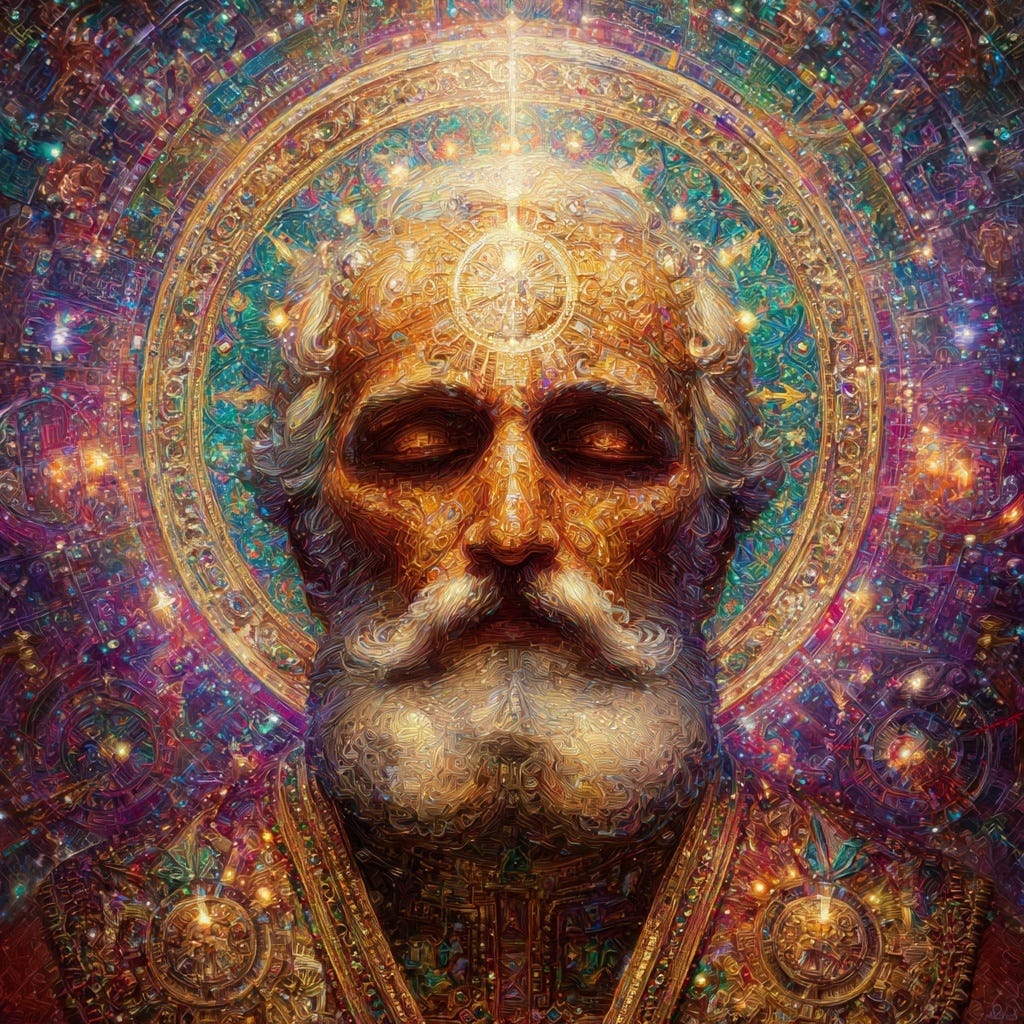
What if strength was not what we were taught to admire — not dominance, nor victory, nor the power to impose — but something quieter, deeper, and harder? What if real strength was the capacity to hold three things together in the same mind without letting any of them collapse under pressure: truth, love, and courage?
Most people can do one. Some can maintain two. But almost no one carries all three at once — at least not for long.
Christness is the ability to hold truth, love, and courage in balance — without dropping any of them, even under pressure.
Not religion. Not performance. Not moral theatre. Christness is an operating system for the soul, a way of being in which the self becomes transparent enough for something larger and cleaner to move through it. It is not about perfection — it is about alignment. When a person is uncentered, the ego fills the space with its games and its needs: to be right, to be liked, to be safe. But when a person aligns truth, love, and courage, something remarkable happens: the ego dissolves like a shadow when the sun rises.
This is why the great saints did not merely behave differently. They were different. Their interior physics changed. And the world around them responded.
The Absence of Ego
Ego is always calculating: How do I look? Am I winning? Do they approve of me? Christness is indifferent to all of this. Not dismissive — just uninterested. When the ego no longer needs to defend or inflate itself, the mind becomes spacious. There is no need to posture. No impulse to retaliate. No hunger to be recognized. Suddenly, instead of reacting, one can respond. Instead of flinching, one can remain. And instead of being a center of gravity pulling everything inward, one becomes a passageway — something light can pass through.
Saint Francis did not walk barefoot to prove humility. He simply no longer required the comfort or the status that others spent their lives chasing. Teresa of Ávila did not levitate to impress anyone. She often begged God not to let it happen in public. When her sisters reported her rising during prayer, she wept — not from fear, but from embarrassment. The ego wants to be seen. The saint wants to disappear.
Ego says: observe me.
Christness says: let God move through me.
And when the ego is gone, what remains is astonishingly powerful.
The Strange Physics of Alignment
When love is pure — not sentimental but fierce in its commitment to the good — it becomes creative. When truth is welcomed without defense, it becomes liberating. When courage is chosen over comfort, it becomes transformative. And when all three are fused, the world behaves differently around such a person. Whether one interprets this metaphysically or psychologically hardly matters; the results are recorded not in myth, but in history.
Consider these:
St. Joseph of Cupertino, simple and uneducated, could barely pass his theology exams — yet during Mass he would rise like a flame from a candle. Not once. Not twice. Seventy documented levitations, witnessed by crowds, priests, even inquisitors sent to expose him. They could not explain him, so they hid him.
St. Padre Pio bore wounds in his hands for fifty years, healed people through prayer, appeared in two places at once, and read souls with the accuracy of someone listening to secret thoughts as clearly as spoken words. Even skeptics left him trembling.
St. Catherine of Siena lived for years consuming nothing but the Eucharist, dictated letters while in ecstasy, and persuaded a pope to return to Rome with a clarity that seemed to pierce illusion itself.
St. Teresa of Ávila, while writing about mental prayer like a neuroscientist of the soul, entered states so deep that her body lifted from the ground. She would cling to the floor to remain.
St. Francis of Assisi spoke with animals as though they were brothers, tamed a wolf that terrorized a town, and walked into the camp of the Sultan unarmed in the middle of the Crusades. He expected death. Instead, he was welcomed like a friend.
Miracles were not achievements. They were side‑effects. Evidence of an inner coherence so total that the laws of fear no longer governed them.
We call such things supernatural only because we live divided. To them, it was simply what happens when nothing inside is resisting love.
Why Miracles Come Only to the Humble
The ego wants to perform miracles. It imagines fame, reverence, spiritual significance. It craves being seen as holy. But the miraculous appears only where ego evaporates — where the person no longer wants to be the one who does anything.
Christness is not power. It is powerlessness rightly understood. The ego tries to conquer the world; Christness simply stops resisting reality. And reality, when unresisted, opens like a door.
This is why saints glow. Why people felt peace simply by standing near them. Why animals followed Francis. Why hardened men confessed secrets to Padre Pio without him speaking a word. This is not magic. This is what a human being looks like when the defensive architecture of ego has collapsed and the light behind the personality shines unfiltered.
To the world, ego seems strong. But the saints demonstrate the opposite: ego is what makes you heavy. Christness makes you light.
A More Subtle Miracle
Not every miracle is spectacular. Some are unphotographable. The quietest ones might be the greatest:
The miracle of remaining gentle when you could be cruel.
The miracle of telling the truth without losing warmth.
The miracle of acting bravely without needing credit.
The miracle of being free from the opinion of others.
The miracle of loving someone without possessing them.
In a frantic world, a non‑anxious presence is already a disruption of physics.
Most of us spend our lives reacting — to fear, to praise, to threat, to expectation. But the one who has dissolved ego does not react. They respond. Slowly. Clearly. From a deeper place than the nervous system. That is itself miraculous.
One could argue that walking on water is less rare than walking through daily life without resentment.
Christness Is Possible
If Christness were simply about miracles, it would be inaccessible — a legend, not a path. But saints insist on the opposite: it is for everyone. Not to levitate, not to bi‑locate — but to become whole. To align love with truth, and truth with courage, and courage with love. This is not an achievement. It is a practice of un‑doing.
A stripping away.
A simplifying.
A returning home.
The saints were not extraordinary because they were chosen. They became extraordinary because they stopped choosing ego. They surrendered the need to win. They told the truth even when it cost them. They loved beyond convenience. They acted even when afraid. And slowly, the world around them began to behave strangely — like iron moving around a magnet.
Christness is not the miracle.
Christness is what makes miracles possible.
Not by force — but by alignment.
And So the Real Work Begins Here
Not by imitating the miracles, but by imitating the inner emptiness they required. By letting the ego soften. By saying yes to truth even when uncomfortable. By choosing love even when inconvenient. By acting bravely even when uncertain. By stepping aside so something larger can step through.
Christness is not a belief system.
It is a way of being practiced in real time.
On a bus.
In an argument.
While washing dishes.
While forgiving someone who isn’t even sorry.
While remaining kind without needing to be seen as kind.
No lightning. No halos. Just a mind becoming clear enough that the light behind it shines through.
And light, when unobstructed, behaves mysteriously.
Miracles are simply what happens when there is nothing left in the way.