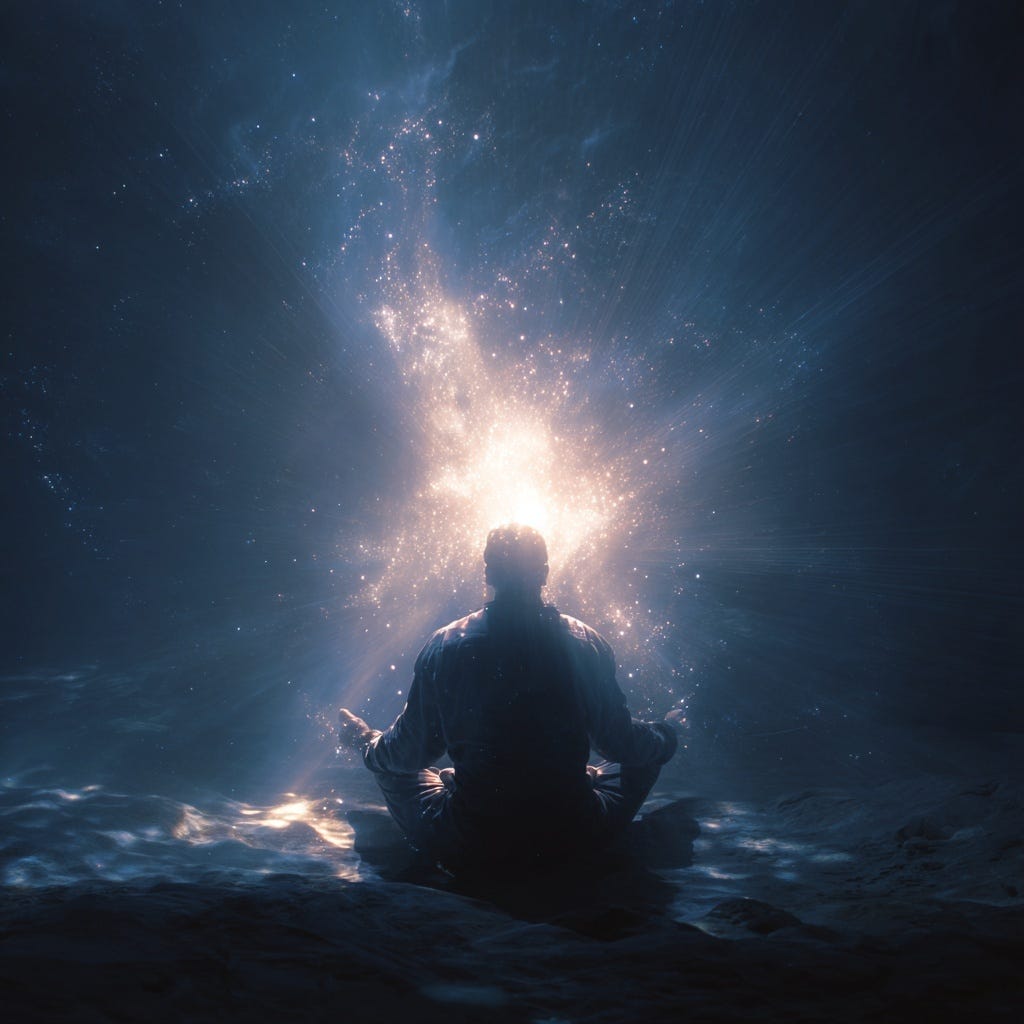
Most people spend their lives trying to reach the source, or God. They pray more, do more rituals, perform more devotion, hope for grace, confess sins, follow dogma. On the surface, this seems like the right approach. After all, religions around the world have taught that God is something distant, something above, something beyond — a sovereign to be obeyed, appeased, served. Church, temple, mosque, synagogue all reinforce this: God is other; you are not.
But what if this entire frame is backwards? What if — as so many of the deepest thinkers and traditions have intimated — God is not something to be reached by doing more, but by subtracting the noise that obscures a reality already present?
The Central Misconception: God as External vs. God as Immanent
When Christianity became a dominant cultural institution in the West, it didn’t simply teach spirituality — it redefined it. Over centuries, the message morphed into something the earliest mystics would hardly recognize:
God is somewhere out there, and you need intermediaries, obedience, fear of punishment, and ritual to approach Him.
That is a far cry from what Jesus himself appears to have taught, if we read the texts with attention to their mystic currents rather than institutional gloss. In the Gospel of Thomas (a text not canonized by early Church councils but preserved by scholars and mystical traditions), Jesus is quoted saying something remarkable:
“The kingdom of God is within you and outside you.”
And elsewhere, “Split a piece of wood — I am there. Lift up the stone, and you will find me there.”
The implication is not of a distant, external judge but of immanence — God as presence, within and through all things.
Even in the canonical gospels, Jesus’ most pointed instruction to seekers was not to perform more, but to see more clearly — to let go of attachments, to forgive, to shed illusions. This is remarkably parallel to what we find in Eastern spiritual traditions.
Eastern Wisdom: Shedding Layers to See the Light
In Buddhism, the path is not one of accumulation — it is one of eradication. The Buddha taught that suffering (dukkha) arises from attachment, craving, clinging. The Eightfold Path is not about adding a bunch of beliefs; it is about removing ignorance, aversion, and craving so that one sees reality as it is. The metaphysical correlary is that there’s no separate self waiting somewhere — there’s only the flow of awareness unguarded by ego.
In Advaita Vedanta, a school of Hindu thought rooted in the Upanishads and elaborated by thinkers like Adi Shankaracharya, reality is described as non-dual (advaita) — there is only Brahman, the infinite, undivided ground of being. The individual self (Atman) is not other than Brahman. The sense of separation is the illusion (maya). The spiritual task is not to attain Brahman (because it’s already the case) but to remove ignorance that makes it seem otherwise. Liberation is not a climb — it is a recognition.
Even in Taoism, the Tao that can be spoken is not the eternal Tao. Laozi’s Tao Te Ching emphasizes wu wei — often translated as “non-action” or “effortless action” — the idea that true harmony arises not from pushing forward but from aligning with the way things already are and letting constraints fall away.
Across these traditions, a pattern emerges:
The divine isn’t distant. The self isn’t a fortress to be liberated by force. Connection happens when interference — fear, ego, trauma — is cleared.
Why Western Religion Turned It Around
If these ancient insights are so compelling, why did Western religion develop in the opposite direction?
History gives us clues. When Christianity became aligned with political power — especially after Constantine and the institutionalization of the Church — it had to serve functions beyond personal liberation. Religious institutions became social regulators, political partners, moral enforcers. A message of internal connection to the divine doesn’t serve an empire’s need for stability, obedience, hierarchy. But a message of obedience to authority, fear of divine punishment, and ritual compliance does.
Thinkers like Nietzsche — who suffered under the weight of Christian dogma and the moralism of European societies — saw how Christianity had inverted human flourishing. In The Genealogy of Morals he argued that what became “moral” in Western society was not a celebration of life and strength, but a domestication of human potential through guilt and fear.
From another angle, Søren Kierkegaard, often considered the father of existentialism, insisted that Christian institutions had lost the personal, inward relationship to God that Jesus taught. For Kierkegaard, authentic faith was not obedience to dogma, but a tense, individual confrontation with the divine — what he called the leap of faith. Yet even Kierkegaard acknowledged how fatally the institution had ossified the spirit.
In the United States, figures like Ralph Waldo Emerson and the Transcendentalists rejected the rigid dogmas of institutional religion and placed emphasis on the individual’s direct experience of the divine — what Emerson called the Over‑Soul, an underlying unity connecting all life. Emerson’s essays pulse with the conviction that we are not separate from God, but part of the same infinite process.
Psychological Blocks: The Real Walls Between You and the Divine
Whether you look at religion through history, or psychology, or personal experience, the real barriers are internal, not external:
Fear and shame — the sense that you are not worthy, that you are alienated from God.
Trauma and hurt — emotional wounds that become neural grooves, shaping how you feel about yourself and the world.
Ego narratives — the stories you tell yourself about who you are, what you can and cannot do.
Habitual reactions — the knee‑jerk patterns that dominate your life without your conscious consent.
None of these are metaphysical forces. They are psychological and behavioral. But they operate like walls between you and the immediate experience of your own life — the same life that, according to most mystical traditions, is God itself.
In modern psychology, pioneers like Carl Jung explored how trauma and the unconscious distort the psyche. Jung’s concept of the shadow — the repressed parts of ourselves — resonates deeply with this theme. The shadow isn’t something to be banished; it’s something to be integrated. Only when we face our hidden fears do they lose their power over us. And the result is a kind of wholeness — a lifting of blocks, a clearing of mirrors.
The Misuse of Spiritual Narratives
So why do so many people still feel disconnected from God, even when they long for connection?
Because our systems — religious, cultural, psychological — teach us to look for salvation outside ourselves. Prayer becomes a plea rather than a conversation. Ritual becomes a shield rather than an invitation to introspection. Moral rules become chains rather than tools for self‑understanding.
The evangelist C.S. Lewis, in his later years, recognized this paradox. Even as a defender of Christianity against materialism, he acknowledged that spirituality could be misunderstood — that the Christian journey must be inward before it can be outward. But institutional religion often substitutes obedience for understanding.
In economic terms, psychologist Abraham Maslow spoke of self‑actualization — the realization of one’s fullest potential. But Maslow later added the idea of self‑transcendence — going beyond self to a kind of unity with something larger. That’s the territory of mystics: Christians like Meister Eckhart, Sufis like Rumi, Vedantins like Shankara, Buddhists like Milarepa. They didn’t add doctrines to get closer to God — they stripped away illusions until only the luminous core remained.
What Really Works: Subtraction, Not Addition
If connecting to God is about removal, then what does that look like in practice?
It looks like:
Silencing the internal critic — recognizing it as fear masquerading as protection.
Facing what hurts without turning away — trauma loses its charge when acknowledged.
Dropping the need to be special or unworthy — both are egoic distortions.
Seeing thought as a tool, not a jailer — thought can illuminate, but it can also trap.
This is why contemplative traditions across cultures stress stillness — meditation in Buddhism, dhyana in Hindu practice, hesychasm in Eastern Orthodox Christianity. Stillness isn’t passive. It’s a clearing.
Albert Einstein once said, “The most beautiful thing we can experience is the mysterious. It is the source of all true art and science.” But mystery isn’t something external — it’s the silence beneath thought, the ground beneath form. That’s what the mystical traditions are pointing to.
Once the Blocks Fall Away
Here’s the strange and powerful thing: when the barriers drop, the experience is not emptiness — it’s fullness. Not separation — union. Not lack — abundance. You don’t gain God. You realize you were never separate.
And that shift — from “I need something outside me” to “I am the medium of divinity” — is the breakthrough.
It brings:
Power that isn’t egoic dominance, but clarity and presence.
Love that isn’t sentiment, but rooted compassion.
Action that isn’t reaction, but aligned intention.
This is why the deepest mystics never built empires or enforced creeds. They dissolved them. They showed — through life and teaching — that God is not an external boss to appease, but the very ground of being that reveals itself when we stop blocking the view.
Conclusion: A Radical Reframing of God
If connecting to God were about doing more, then the busiest, most devout people would be the closest. But often they are not. They are preoccupied. They are bound by fear of sin, fear of judgement, fear of imperfection.
What if the real spiritual path is not about becoming worthy, but about seeing through the lie that you are unworthy in the first place? What if the work isn’t to add faith, but to clear fear? What if God isn’t a distant judge but the immediate presence you’ve never stopped resisting?
This isn’t easy. Painful things — trauma, fear, shame — don’t release themselves without a fight. But that fight is not against God. It’s against the illusions we’ve built around ourselves. And each layer that falls away reveals a deeper truth: that the divine isn’t something “out there.” It’s the ground beneath your feet, the awareness you are, and the life you live.
And once you see that, everything changes — not because something external came to you, but because something internal was finally allowed to be seen.