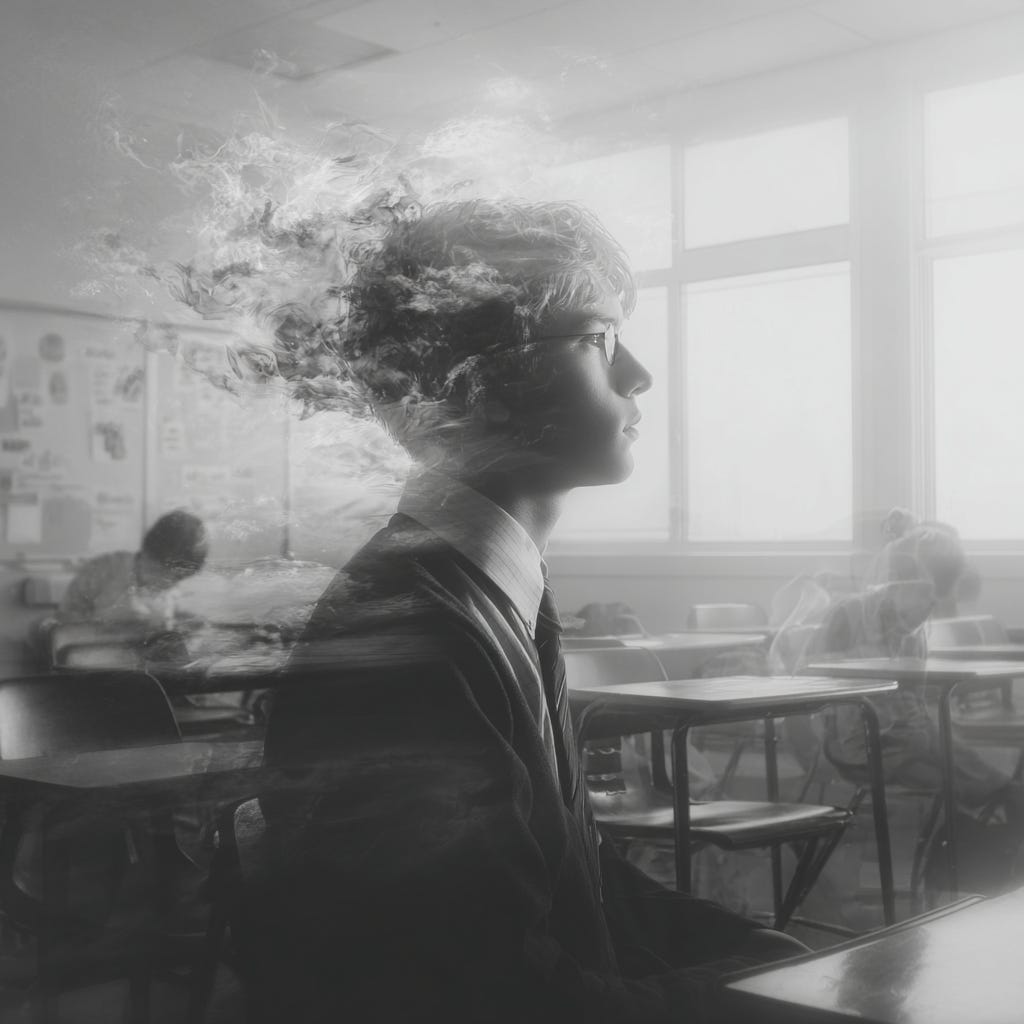
To learn is not merely to receive answers, but to undergo a transformation in one’s own lived experience. At the heart of such learning lies a voice we seldom acknowledge — the inner dialogue that emerges when a person is alone with a question, wrestling within the indeterminacy of experience itself. Education without this dialogue is like a map without territory, a script without a stage, a body without sensation. Phenomenology — the philosophical study of lived experience — reveals that the true horizon of education is not external information but the interior terrain of consciousness.
I. The Phenomenological Ground of Learning
Phenomenology begins with a simple but radical claim: we should describe experience as it is lived, before we analyze it or explain it away with theories. Edmund Husserl, the founder of phenomenology, urged us to “go back to the things themselves” — meaning that we must attend to the structures of consciousness as they appear, without reducing them to psychology or behaviorism.¹
When a student sits with a problem, the first phenomenon is not logic or curriculum, but presence: a body in a room, a horizon of expectation, an inner murmur of doubt and anticipation. This murmur is not noise; it is the inner voice that Aristotle later called logos endiathetos — the reasoning that talks to itself within us.²
In learning, this internal movement of thought is primary. We recall how it felt, as children or adults, to struggle with an idea: the tension in the chest, the subtle shift when insight dawns, the silent conversation between I don’t understand and Wait… maybe this. This is the lived structure of understanding.
II. Inner Dialogue and the Greek Legacy
Your insights into the Greeks resonate phenomenologically because they too describe the felt quality of inner orientation.
1. Socrates’ Daimonion
Socrates spoke of his daimonion — a distinct inner voice that restrained him from error without offering prescriptions.³ From a phenomenological standpoint, this voice is not an oddity but an instance of consciousness’s self-checking movement. It reveals how we feel the difference between what is authentic and what is merely reactive. The daimonion is, in experience, a pause before an action — a hush before commitment. In Husserlian language, it is a self-givenness of one’s own intentionality: I am aware that I am about to act, and something within me hesitates because it senses the relevance of the act to the world and to myself.
2. Stoic Logos
For the Stoics, to live according to nature meant to align with the logos, the rational principle that permeates the cosmos.⁴ Merleau‑Ponty, a twentieth-century phenomenologist, echoes this when he describes perception not as passive reception but as an active engagement with a meaningful world.⁵ The Stoic stress on living in conformity with the logos is phenomenologically akin to describing how the world feels structured — how some actions feel in harmony with our own sense of self and environment, and others feel alienating.
3. Plato’s Anamnesis
Plato’s doctrine that knowledge is a kind of remembering, that learning is recollection of what the soul once saw, is often read metaphysically. But phenomenologically, it points to the familiarity that underlies genuine insight: when we finally grasp a truth, it feels as if we’ve always known it somewhere deep inside. This “aha!” moment is no metaphor; it is a description of the texture of awareness.
III. The Modern Educational Void
In many contemporary classrooms, education is treated as the delivery of information — a queue of facts, skills to be tested, performances to be measured. Rarely is the internal life of the student treated as the locus of meaning. Teachers speak; students absorb. But phenomenologically, absorption is the opposite of participation. To absorb is to take in; to engage inner dialogue is to participate in the unfolding of meaning.
Imagine the interior landscape of a student at such a moment: a felt pressure in the brow, the hesitant narrowing of attention, the subtle interplay of hope and doubt. This is not disorder. This is meaning in formation. Husserl describes intentionality as the structure by which consciousness is always “about” something — not a data bank but a living relation to phenomena.⁶ A classroom that ignores this interiority reduces learning to data transfer and cuts students off from their own capacity to interpret.
IV. Why Inner Dialogue Matters
Learning, phenomenologically, is not just acquiring correct answers. It is an event that occurs within the textures of experience — the silence between thoughts, the sense of surprised recognition, the resonance that follows understanding.
Martin Heidegger, another phenomenologist, argued that human being is being-in-the-world — meaning that we are not isolated subjects but existing through our concerns and involvements.⁷ A student who experiences a concept does so not abstractly, but as something that matters to them, in their situation, with their history of attempts and failures.
Inner dialogue is the felt bridge between ambiguity and clarity. It is where confusion is not an obstacle but the opening through which understanding enters.
V. Education as Cultivation of Interior Experience
If education is to be more than training, it must attend to the structures of experience. But what does that mean in practice?
It means:
Encouraging reflection: not summaries, but deep articulation of what it felt like to question, to resist, to discover.
Valuing hesitation as a legitimate stage of thinking, not a flaw.
Creating spaces where students are invited to hear their own questions, not just answer given ones.
Recognizing that insight is not a product but a process — an unfolding in consciousness.
This aligns with phenomenology’s insistence that meaning is not imposed from outside but lived from within. Insight is not something bestowed by a teacher; it is something birthed in the student’s own experience.
VI. Conclusion: From Noise to Voice
Education that ignores inner dialogue trains performers, not thinkers. But real education cultivates a felt voice within — a voice that speaks in the hush of thought, that hesitates before the wrong move, that resonates with the affirmation of discovery.
Phenomenology teaches us that every moment of consciousness is a presence — not a blank slate, not a passive receptor, but an active field where meaning shows itself. When a student comes to say “Oh, now I see,” they are describing not just a cognitive shift but a lived transformation. To teach without attending to that transformation is to teach ghosts, not human beings.
Education needs inner dialogue because inner dialogue is the terrain where experience becomes understanding. Without it, learning remains noise. With it, it becomes voice.