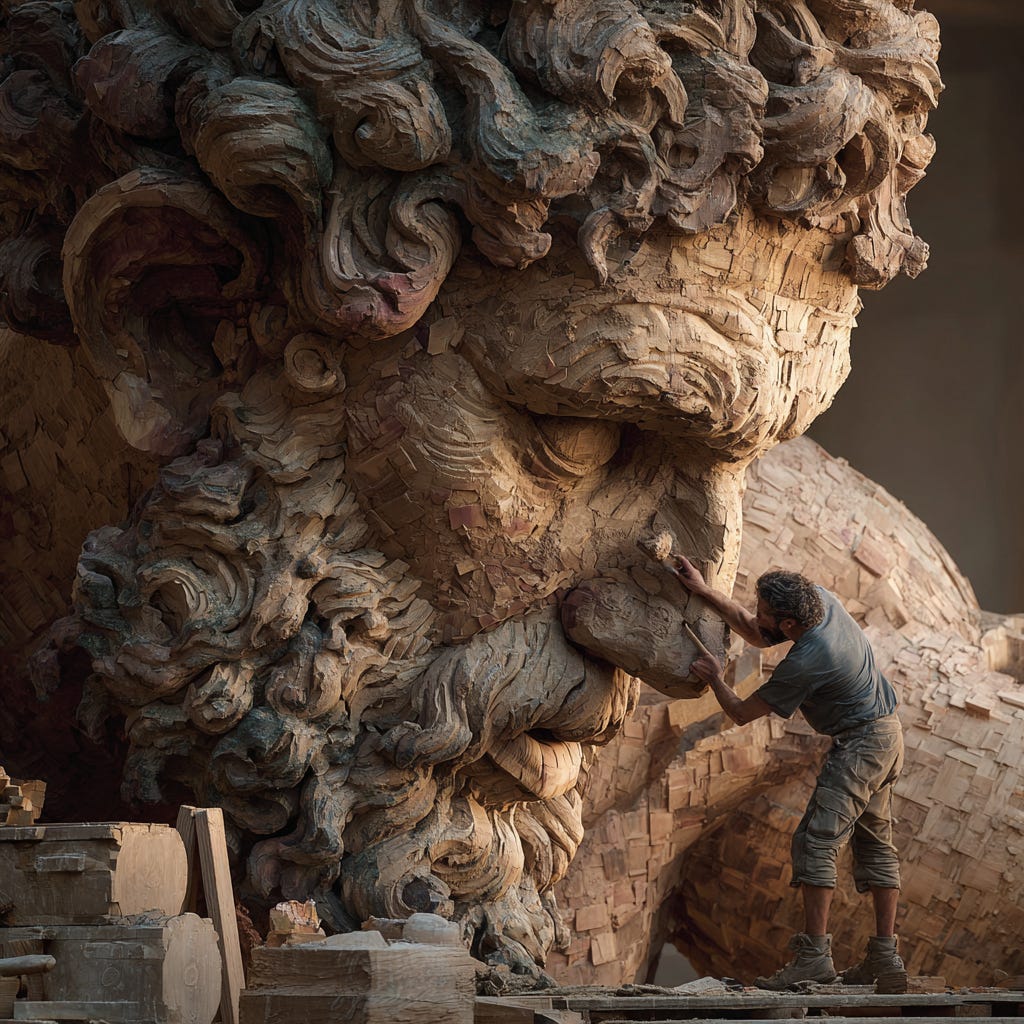
“Every block of stone has a statue inside it and it is the task of the sculptor to discover it.”
Michelangelo said that. Or is said to have said it. Either way, it’s one of those phrases that sticks because it feels true — not just for marble, but for almost any kind of creative process. There’s something buried inside the raw material, and your job is to find it. But here’s the twist when it comes to AI: you don’t get the block for free.
In the age of language models, people imagine AI as this vast oracle that you summon with prompts, and it delivers knowledge, insight, or beauty. Like a search engine that can suddenly write novels. But using AI well is not about pulling brilliance out of thin air. It’s about assembling the marble yourself, shaping the raw inputs, and then carving with intent. The AI is a collaborator, not a magician.
That’s why I say: working with AI is modern sculpting. But not the kind where you get handed a perfect block and start chiseling. It’s the kind where the rock is what you feed it, the chisel is your perspective, and the sculpture is your goal. And unless you bring all three — good material, a sharp lens, and a clear objective — all you’ll get is noise in fancy grammar.
The Rock: You Feed It
Most people don’t realize how passive their approach to AI is. They open the tool, type something vague — “write a blog post about innovation” — and then sit back like it’s supposed to create something amazing. When the output’s bad, they blame the tool.
But AI isn’t generative in the way most people think. It’s reactive. It responds to your framing, your feed, your energy. If you give it garbage — thin context, shallow insight, tired tropes — that’s what it will regurgitate. If you give it clarity, depth, structure — it starts to produce something with edge.
So the real work starts before you generate anything. You have to think: what do I want this thing to understand? What references matter? What tone? What context? What’s the core material it needs to shape the right kind of response? The quality of the rock determines what sculpture is even possible. That’s your job — building the rock.
This is the opposite of how most people think about AI. They imagine the model as intelligent, so they underprepare. But in reality, the better your preparation, the more it looks intelligent. And that’s the paradox: the more you bring to it, the more it gives back. It’s a mirror, not a mind.
The Chisel: Perspective as a Tool
Once you’ve chosen your material, you still need to know how to look at it. That’s where your angle comes in. The sculptor doesn’t just see a rock. She sees a shape inside it. But what she sees depends on where she stands. Change the angle, and the shape changes.
The same is true when working with AI. Your perspective — your way of seeing the world — is what gives direction to the process. AI can mimic any voice, reflect any bias, fill in any blank. But you have to decide which way you’re facing. What’s the story behind the story? What lens are you applying to the data? What question are you really asking?
Perspective isn’t decorative. It’s not just your personal “take.” It’s an instrument. You’re choosing a frame that tells the model how to structure the material. Without it, you’re not sculpting — you’re just rearranging sand.
This is where the real power comes in. Most people use AI to produce content. But the people who get value out of it are using it to explore their own lens. They already know what they’re trying to see. They use the model to clarify it, to test it, to sharpen the edges.
AI doesn’t teach you how to see. It amplifies what you already see.
The Vision: Goal as the Guide
Even with good material and the right angle, you can still fail — if you don’t know what you’re trying to make. A sculptor doesn’t just chip randomly. She has a form in mind. It might change in the process, but the direction is clear. She’s moving toward something.
When you use AI, your goal is your form. It’s the sculpture you’re trying to pull from the noise. Without a goal, every output looks equally plausible. You can’t tell what’s good or bad — just what’s long or short, fancy or plain. But with a goal, suddenly you can tell: this paragraph moves us forward, that one drags us off course. This version opens a new insight; that one just fills space.
And this is where most users give up. Not because the AI is weak — but because they are uncertain. They don’t know what they want, so they can’t recognize it even when it appears. Using AI well demands clarity — not just of topic, but of purpose. What are you really trying to say? Who is this for? Why does it matter?
If you don’t know, neither will the machine.
Iteration: The Art of Refusal
Even when everything is aligned — good material, strong angle, clear goal — the first outputs will usually be wrong. Not catastrophically wrong. Just not right. They’ll be generic, a little soft, not quite pointed. That’s not a failure. That’s the point.
Working with AI is iterative because sculpting is iterative. You push. You reject. You adjust. You re‑ask the question slightly differently. You try it from another lens. And then another. The key is not just prompting — it’s refining. It’s knowing what to discard. In a world where the machine gives you 1,000 drafts in a minute, the hardest part is knowing which 999 to throw away.
This is where taste matters most. Your ability to detect what feels true, sharp, or useful — even before it’s polished — becomes the real bottleneck. The better your taste, the more you can get out of even rough output. The worse your taste, the more you’ll be fooled by pretty nonsense.
The Final Cut: AI Doesn’t Replace Makers
There’s a quiet panic in the creative world right now. People are afraid that AI will replace writers, designers, thinkers — anyone who makes something out of nothing. But that fear is based on a misunderstanding.
AI doesn’t replace creativity. It tests it.
If you don’t know how to feed it, you’ll drown in junk. If you don’t know how to look at the problem, you’ll generate answers that go nowhere. And if you don’t know what you want, you’ll get lost in the noise. In that world, AI won’t make you faster. It will make you mediocre — faster.
But if you know what you’re doing — if you have taste, vision, and judgment — then AI becomes leverage. Not because it’s smart. But because it’s fast. You can test twenty angles in a day. Try five styles in an hour. Get a rough idea onto the page and sharpen it without friction.
AI doesn’t turn bad thinkers into good ones. But it turns good thinkers into prolific ones.
And that’s the future. Not tools replacing people. Tools amplifying them. The sculptors of the new era won’t be the ones who “know prompts.” They’ll be the ones who know where the statue is — and what rock to build it from.