
The Assignment
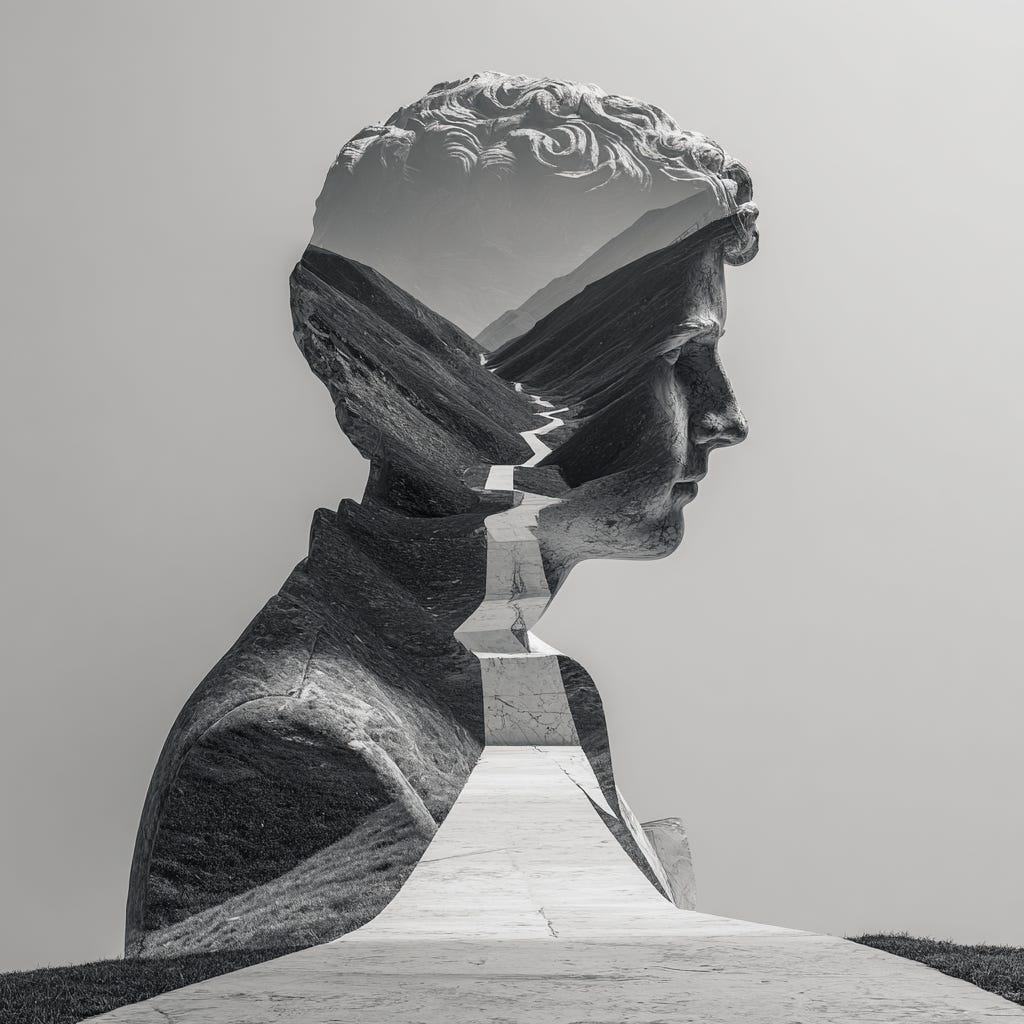
Purpose begins with assignment: a chosen demand where soul meets world. Freedom is not limitless choice, but finding what is truly yours and choosing it.


We talk about purpose as if it were something hidden inside us. Like a gold coin at the bottom of a well. The problem is to find it.
But I don’t think purpose is like that. Purpose is not a substance. It is a direction. And directions only exist once there is somewhere to go.
So perhaps the first fact about purpose is this: there is no purpose without an assignment.
This sounds less romantic than “find your purpose,” but it may be more accurate. A person with a child has a purpose, at least for the moment. So does a doctor in an emergency room. So does a founder whose users need him, a soldier guarding a bridge, a monk praying at dawn, a writer trying to say the one thing he cannot quite say. In each case, purpose appears because there is an assignment.
The assignment may be chosen, inherited, discovered, imposed, or accepted. But without it, purpose has no shape. It is just a feeling looking for an object.
This is why freedom can feel so strangely empty. We imagine that freedom means having no assignment. No boss, no family expectations, no God, no country, no duties, no constraints. Just pure possibility. But pure possibility is not purpose. It is white noise. A life with no assignment is not a life of infinite meaning. It is often a life of drift.
The Greeks understood this better than we do. Aristotle thought every being had a telos, an end toward which it naturally moved. An acorn becomes an oak. A knife cuts. A human being flourishes by living according to reason and virtue. Modern people tend to dislike this idea because it sounds as if the assignment has already been written. And maybe that is too simple. Human beings are not acorns. An acorn cannot decide to become a poet.
But Aristotle saw something important: meaning is connected to function. A thing becomes intelligible when we know what it is for.
The disturbing question is whether human beings are “for” anything.
The religious answer is yes. God gives the assignment. The existentialist answer is no. There is no assignment until we create one. Sartre said existence precedes essence: we appear first, and only later define ourselves by choosing. Nietzsche went further. If the old tables of value have collapsed, the noble task is not to obey values but to create them.
But both answers may be too clean.
It does not feel true that the assignment is simply handed down from above, as if we were employees receiving instructions. But it also does not feel true that we invent ourselves from nothing. No one chooses from nowhere. We choose with a temperament, a body, a history, a wound, a gift, a longing, a fear, a set of loves we did not vote on. Even rebellion begins somewhere.
You can choose your assignment. But the “you” doing the choosing is not a blank committee room.
Where does the choice come from?
Partly from values. But where do values come from? Partly from experience. But why did one experience mark you while another passed through you without leaving a trace? Partly from desire. But why this desire and not another? Augustine said, “My love is my weight.” We are carried by what we love. But we do not seem to have chosen all our loves. Some of them choose us first.
This is where free will becomes interesting. The usual debate about free will is framed badly. It asks whether we are completely free or completely determined. But no one lives either of those lives. We are obviously not completely free. I cannot decide to have been born in another century. I cannot decide not to need sleep. I cannot decide that the people I love are replaceable. I cannot decide that gravity is optional.
But we are not merely billiard balls either. We deliberate. We hesitate. We admire one possible self and feel disgust for another. We can say yes to an impulse, or no. We can educate desire. We can make promises. We can betray them. We can become ashamed. A machine does not become ashamed.
So maybe free will is not a sovereign issuing commands. Maybe it is more like a dance.
A dance is neither pure freedom nor pure constraint. The dancer is constrained by music, by gravity, by the body, by the floor, by the partner. But within those constraints something real happens. In fact, the constraints are what make the dance visible. A dancer floating in empty space would not be dancing. He would be flailing.
So perhaps a human life is a dance between the soul and the world.
By “soul” I don’t necessarily mean a ghostly substance. I mean the deep pattern of a person: what they are drawn to, what they cannot bear, what they notice, what they return to, what makes them feel more alive rather than merely more successful. The soul is not the same as personality. Personality is often just the costume the soul wears in public. Nor is it the same as appetite. Appetites are loud and short-lived. The soul is quieter and more persistent.
The world supplies the music. It gives us limits, accidents, needs, dangers, invitations, humiliations, teachers, enemies, markets, languages, parents, cities, technologies, illnesses, wars, and chances. The soul responds. Sometimes it resists. Sometimes it recognizes something. Sometimes it says, without quite using words: this is mine.
That moment of recognition may be the beginning of assignment.
But many people never reach it. They do not fail because they lack talent. They fail because they accept the wrong assignment too early.
There are many false assignments. Become impressive. Make your parents proud. Win the game everyone else is playing. Be beautiful. Be rich. Be safe. Be normal. Be extraordinary in a way other people will understand immediately. These assignments are powerful because they come with applause. They also come with maps. You can usually tell how you are doing.
A real assignment is more frightening because at first it may not look like an assignment at all. It may look like an obsession, an irritation, a private curiosity, a recurring anger, a kind of homesickness. Socrates called his inner guide a daimonion, a voice that warned him when something was false. Kierkegaard thought the self became itself by relating itself honestly to itself before God. Heidegger spoke of the call of conscience, which summons us out of the anonymous life of “they” into our ownmost possibility.
These are different languages for a similar event: something interrupts the borrowed life.
The borrowed life is not always miserable. That is what makes it dangerous. You can succeed inside it. You can get promoted, praised, married, envied. You can become very good at completing assignments that were never yours. And because success produces evidence, you may not notice the fraud for a long time.
But the soul keeps accounts.
It charges interest in boredom, resentment, envy, and the strange sadness one feels after getting exactly what one wanted.
A genuine assignment has a different quality. It is not always pleasant. In fact, it may be harder than the false one. But it produces a cleaner kind of suffering. You may be tired, but you are not divided. You may be afraid, but you are not hollow. The work asks something from you, and the demand itself feels like evidence.
This is why “follow your passion” is weak advice. Passion is too unstable. The better question is: what demand makes you more real when you obey it?
A parent waking at night to comfort a child is not following passion. A scientist spending ten years on a problem no one understands is not following passion in the usual sense. Simone Weil wrote that attention is a form of prayer. There is a kind of attention that is almost obedience. You look at something long enough, and eventually it starts making claims on you.
That is assignment.
The modern world makes this harder because it multiplies possible assignments. A medieval peasant had too few choices. We have too many. We are not crushed by destiny so much as dissolved by optionality. We can become almost anything, so we skim across selves. We try on identities the way people try on coats. And because each possible life has some attractive surface, we mistake attraction for calling.
But an assignment is not the thing that looks best from outside. It is the thing that grips you from inside and connects you to a need outside yourself.
That last part matters. The soul alone is not enough. Pure inwardness curdles into fantasy. The world alone is not enough either. Pure external demand becomes slavery. Assignment happens where the two meet. Something in you answers something outside you.
This is also why purpose cannot be purely selfish. A purpose concerned only with the self collapses under inspection. Even the most ambitious people need to feel that the work is not merely self-decoration. The entrepreneur wants users. The artist wants viewers or readers. The philosopher wants truth. The saint wants God. The revolutionary wants justice. Even the tyrant wants history. The assignment has to pass beyond the skin.
But it must not bypass the soul. That is the mistake of duty without inward consent. A person can be conscripted into a noble cause and still be spiritually absent. The act may be useful, even admirable, but it is not yet his assignment in the deepest sense. For an assignment to become purpose, the soul has to ratify it.
So we arrive at a paradox.
You do not create your assignment from nothing. But neither do you merely receive it. You discover it by acting, refusing, listening, experimenting, suffering, and noticing where you become more alive. You are led, but not dragged. You choose, but not from nowhere.
This may be the closest thing to free will we actually have.
Not the freedom to be anything. That is a fantasy. Not the freedom to escape the world. There is nowhere outside the world from which to live. We are made of its materials, bound by its laws, wounded by its history, dependent on its gifts. Even the most creative person is rearranging what already exists. To create is not to escape limitation, but to make limitation sing.
A musician does not complain that there are only twelve notes. A poet does not complain that words already have meanings. A lover does not complain that the beloved is particular rather than infinite. Form is not the enemy of freedom. Form is what freedom uses.
So the question is not whether you are limited. Of course you are limited. The question is whether, inside those limits, you can recognize the assignment that is yours.
And perhaps the deepest form of freedom is not choosing without cause, but consenting to the right cause. To say: yes, this is what I will serve. Not because I was forced. Not because it is fashionable. Not because it guarantees happiness. But because when I turn away from it, I become less myself.
Purpose begins when the soul stops asking, “What do I want?” and starts asking, “What is being asked of me?”
At first that sounds like surrender. But it may be the opposite. It may be the moment a person ceases to be a spectator of his own life.
You are not free because you have no assignment. You are free when you can discover the assignment that is truly yours, and still choose it.
 | A guest post by
|