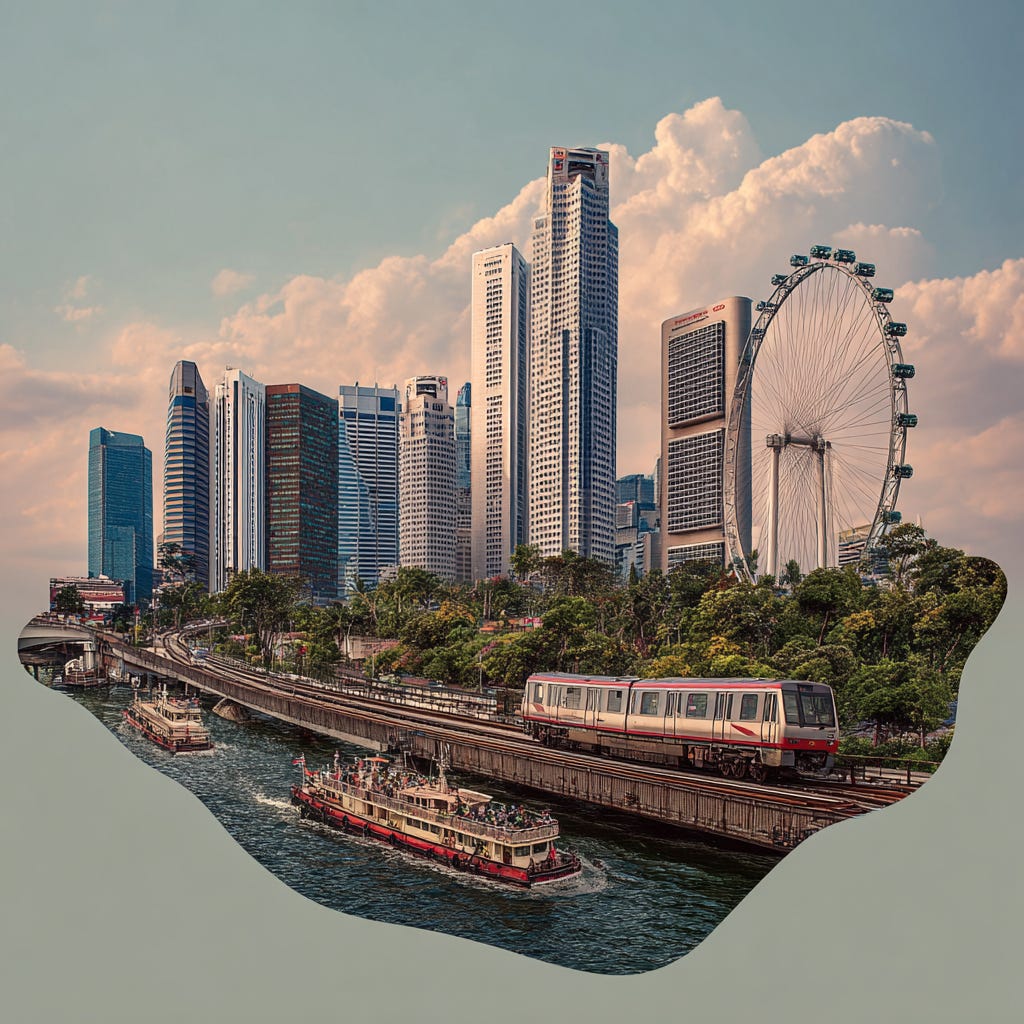
Some cultures fear failure. Some fear chaos. Some fear irrelevance.
Singapore fears being slow.
Not loud, panicked slowness — but the quiet, creeping kind. The kind that doesn’t show up as disaster, but as mediocrity. Obsolescence. Missing the window. Becoming irrelevant while still being technically functional.
That’s the national nightmare: not collapse, but sluggishness.
Underneath Singapore’s tightly run systems is a persistent fear that time is the real enemy. That if it doesn’t move fast enough — to build, to adapt, to ship, to pivot — it won’t just fall behind. It’ll be ignored.
This isn’t paranoia. It’s strategy.
Singapore is small, which means speed is its advantage. It can’t scale like the U.S., or throw weight around like China, or lean on centuries of inertia like Europe. Its edge is how fast it can turn ideas into policies, policies into systems, and systems into results. It’s a machine built not to be first, but to be ready — first.
That kind of readiness doesn’t come from ambition. It comes from fear.
Specifically, the fear of being not fast enough.
You can trace that fear back to 1942, when the Japanese invaded and Singapore realized it had been too slow to see what was coming. The British waited. They overestimated their strength. They underestimated the urgency. The Japanese didn’t. They moved with precision, speed, and overwhelming momentum.
Singapore fell in days.
That collapse wasn’t just military. It was cognitive. A society built on the assumption of protection learned — violently — that assumptions are dangerous. That you can’t wait for others to protect you. That slowness is vulnerability.
When independence came two decades later, that trauma was still fresh. The lesson stuck: don’t wait. Build first. Build fast. Build even if no one believes in you yet.
And so Singapore became not just a country that could plan — but one that could ship.
It didn’t build the world’s best airport because tourists demanded it. It built it because people might. It didn’t become a logistics hub by accident. It bet that speed + order would beat size. And it was right.
Singapore’s entire posture is built around tempo. Not just in politics or infrastructure, but in economics, education, and even diplomacy. You can see it in how it redesigns policy: not once every generation, but constantly. You can see it in how it trains civil servants: not to maintain things, but to move them.
Most governments adjust slowly. Singapore reboots. It iterates. Its ministries are structured to learn, not just enforce. They treat every system — from housing to healthcare to immigration — like a product that can be A/B tested, upgraded, rearchitected.
And all of that comes from fear — the quiet kind that says, “If we don’t move now, we may not get another chance.”
You see it most clearly in how they build. Infrastructure is not reactive. It’s preemptive. Water security, digital infrastructure, green energy, data regulation — they all arrive years ahead of schedule, because the fear isn’t about fixing problems. It’s about running out of time.
In Singapore, speed isn’t just cultural. It’s structural.
The entire system is designed to collapse the delay between decision and execution. And that makes sense. In a country this small, hesitation compounds quickly. A five-year delay in housing policy means social instability. A one-year lag in digital transformation means missing the wave. A three-month miss in supply chain forecasting means a visible dent in GDP.
Most countries can afford drift. Singapore can’t. So it designs it out.
Speed becomes an organizing principle.
It shows up in schools, where kids are tracked into performance paths early, sometimes controversially so. It shows up in startups, where founders optimize for partnerships with state-linked investors who care more about speed to utility than about moonshots. It shows up in immigration — tight, selective, calibrated for who will build the most value, the fastest.
Even when it invests in R&D, Singapore doesn’t follow the hype cycle. It funds areas like AI governance, synthetic biology, green maritime fuel — not because they’re trendy, but because they’re converging. It looks for inflection points early, then gets in place before the rush.
This kind of thinking isn’t normal in government. It’s normal in high-performing startups.
Singapore behaves like a state with a startup’s metabolism. It doesn’t have endless bandwidth, so it doesn’t waste motion. Every policy is a sprint. Every decision is a trade-off. Every plan is a hedge against a slower, clumsier future.
And the country knows it can’t outrun everything. So it picks its lanes. It doesn’t try to be culturally dominant or militarily expansive. It tries to be where things happen first. The first to try, the first to adapt, the first to be ready.
This readiness is visible even in its architecture. Singapore doesn’t just build tall — it builds integrated. You don’t just get housing. You get transit, retail, schools, and parks, all in one. Vertical cities designed like software — compressed, layered, efficient.
They do this not for style points, but because it’s faster.
Efficiency is not a slogan. It’s a survival skill.
And the whole economy is built around it. Singapore doesn’t try to do everything. It tries to be the platform others build on. Global capital, shipping, arbitration, tech sandboxes — it offers trust, order, and speed. Come here, build here, ship faster. That’s the pitch.
And it works.
But this mindset doesn’t just create success. It creates pressure. Living in a country that fears being too slow means you’re always running a little fast. You’re always aware that the next version is due soon. That the neighbors are watching. That the global system doesn’t care how tired you are.
This isn’t always healthy. But it’s honest.
Most of the world acts like it has time. Singapore acts like it’s on borrowed time. And that urgency creates leverage.
Because the truth is: being too slow is worse than being occasionally wrong. Mistakes can be fixed. But missed windows don’t come back.
Speed, done right, beats perfect.
That’s the bet Singapore keeps making. Not that it will always be right, but that it will always be first to realize it needs to move. That it will ship before the meeting is scheduled. That it will draft before the press release is out. That it will pivot before the world asks why.
And underneath all of it is that same fear: what if we’re not fast enough this time?
That fear is not weakness. It’s discipline. It’s the heartbeat that keeps a small country from getting soft. It’s the reason decisions get made, not just debated. It’s why Singapore, while rarely the loudest, is often the first to act, the first to adapt, the first to ship.
It’s the fear of being too slow, turned into a strategy.