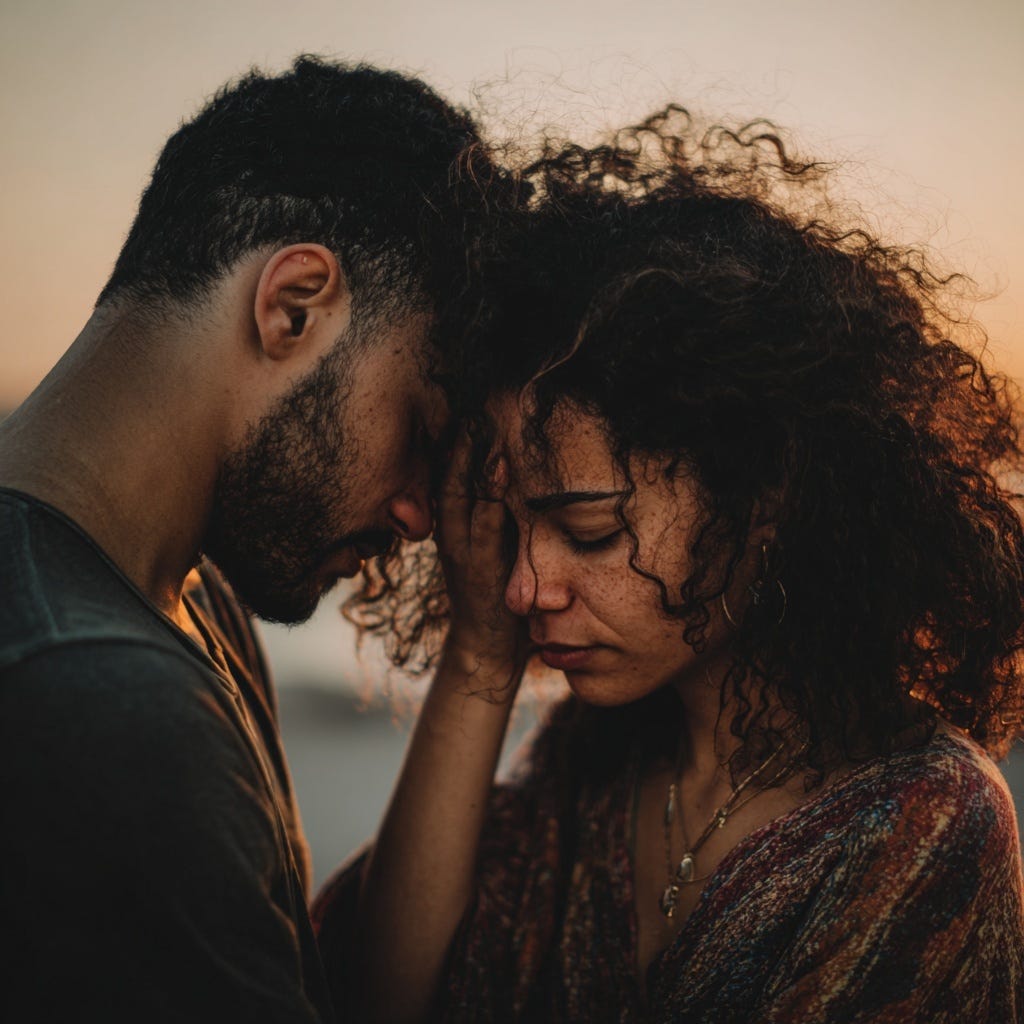
People think relationships are supposed to make you happy. That’s the first mistake. The deeper truth—the one we mostly avoid—is that relationships exist to break us open.
You don’t fall in love to be completed. You fall in love to be exposed.
It took me a while to notice the pattern. A friend would say something like, “I thought she was the one,” followed by, “But then she triggered something in me I didn’t even know was there.” At first, I thought this was just another way of saying things didn’t work out. But it kept happening. In one version or another, people described a moment where love stopped being pleasant and started being diagnostic.
There’s a reason for that.
Most of the damage we carry—the unresolved stuff from childhood, from early relationships, from all the little betrayals we never processed—doesn’t show up when things are easy. It shows up when we’re close to someone who matters. The more intimate the relationship, the more likely it is to bump against the old bruises. Not despite the closeness—but because of it.
And here’s the uncomfortable part: this isn’t a bug. It’s a feature.
We’ve inherited a broken script. Culture sells us the idea that love should be frictionless. That the right person is someone who “gets” us so perfectly that we never feel misunderstood again. But if someone fits us so well that we never feel discomfort, they probably aren’t reaching the parts of us that need healing most. Real intimacy brings the exact kind of tension that unearths buried wounds.
It’s not about being fixed. It’s about being revealed.
I started thinking about romantic partners not as soulmates, but as co-conspirators in excavation. They show up with a kind of unintentional genius. Their flaws align almost too perfectly with our unresolved pain. They don’t even know they’re doing it—most of the time, neither do we. But over time, if both people are paying attention, something unexpected happens: they become the exact person who can help us heal what no one else could.
That’s the hidden promise in committed love—not that someone will always make us feel good, but that they’ll stay through the parts that don’t.
There’s a moment in any serious relationship where you want to run. You hit something tender, and everything in your nervous system says: leave. But if both people are willing to pause, to breathe through the discomfort instead of reacting to it, something shifts. You’re no longer just fighting. You’re doing the work. Not the work of fixing each other. The work of witnessing each other as you are, and choosing to stay anyway.
This might sound heavy. It is. But it’s also a relief. Once you stop expecting love to be painless, every hard moment becomes data. Instead of asking, “Why is this happening?” you ask, “What is this showing me?”
The surprise is that this kind of love—raw, imperfect, confrontational—is also the most durable. Because it’s not built on fantasy. It’s built on reality. It doesn’t require your partner to be perfect. It just asks them to be present. It asks you both to take responsibility not for the other’s pain, but for staying conscious of how you each participate in it.
That’s the real work of love. Not avoiding each other’s wounds, but becoming brave enough to meet them.
So maybe the question isn’t “Is this the right person?” Maybe it’s “Am I willing to do the work with this person?” If the answer is yes, then you’ve already begun the hardest and most beautiful kind of relationship: one that doesn’t just hold your hand through life, but helps you grow into the version of yourself that love has been asking for all along.