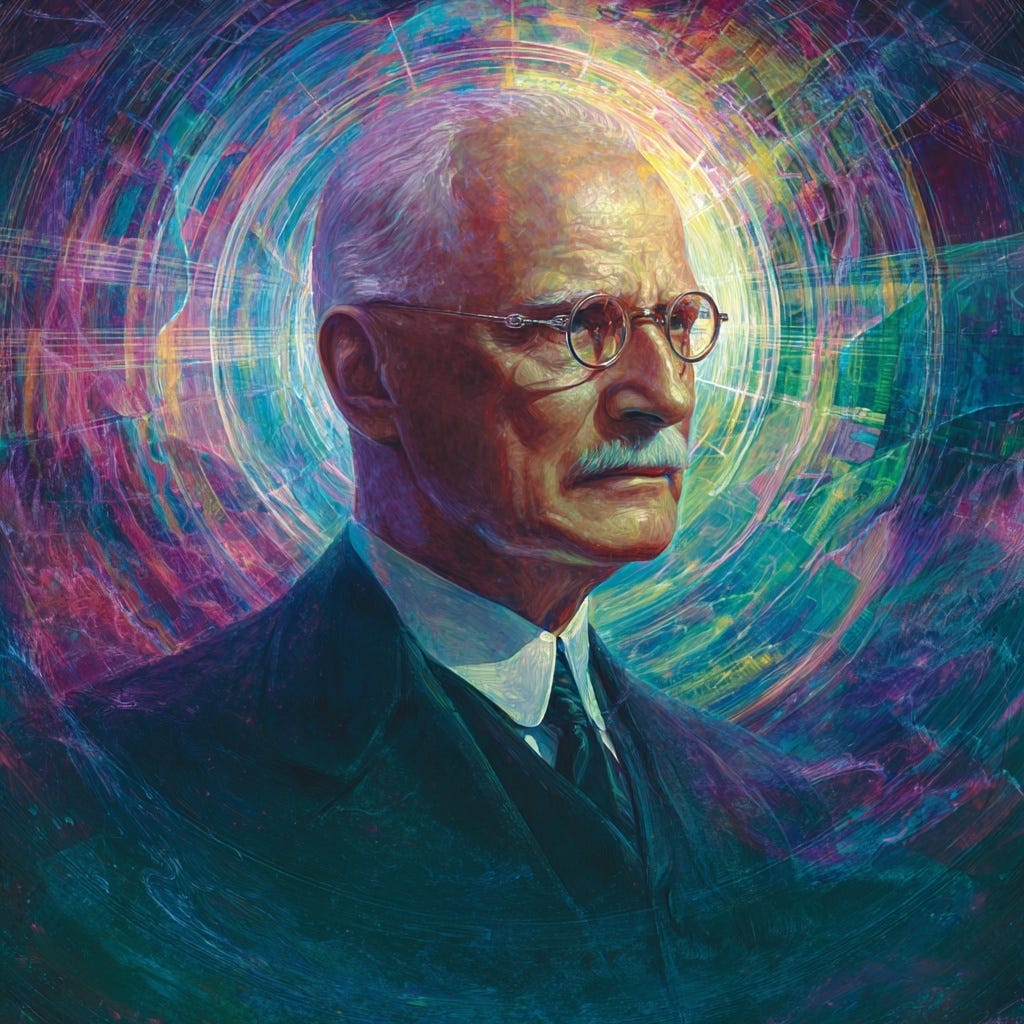
We live in a universe that many modern minds describe as indifferent, mechanistic, and random. Yet, for the sensitive observer — the one who listens within — the world speaks in patterns, echoes, and meaningful resonances that defy ordinary explanation. This essay offers a framework for seeing reality itself as a kind of dialogue — an unfolding text in which every person, event, and moment carries meaning intended for the one who is ready to hear.
The central claim is simple yet radical: the universe speaks to us through meaningful events — not random flickers but resonances between inner life and outer occurrence — and these events often carry messages that are deeply personal, coherent, and transformative.
To make this claim persuasive, we must consider three pillars:
The psychological principle of synchronicity — as originally articulated by Carl Jung
Concrete documented examples of meaningful coincidence
A philosophical view of reality as inherently expressive, not merely causal
Together, these offer a coherent account for why events feel like messages — and why we should take that feeling seriously.
I. Synchronicity: Meaningful Coincidence Beyond Cause
Carl Gustav Jung, the Swiss psychiatrist and founder of analytical psychology, coined the term synchronicity to describe what he called meaningful coincidences — events that occur together not through causal linkage, but through shared meaning. These synchronistic moments feel too apt, too timely, and too resonant to be dismissed as mere chance.
For Jung, synchronicity wasn’t pseudoscience or superstition; it was a psychological principle that connected inner experience (a thought, emotion, dream) with outer events that mirror or respond to that state in a striking way. He defined it as an “acausal connecting principle,” meaning that the link is not one of cause and effect but one of meaningful alignment in time.
Synchronicities appear not as trivial coincidences but as answers, confirmations, or signposts — moments when the inner world and the outer world converge in a way that feels directed. Such events seem to say: “Look here. Listen now. Notice this.”
But what makes these events significant is not merely their rarity, but the fact that they occur at moments of psychological relevance — when an individual is grappling with a question, a decision, or a transformation.
II. Documented Instances: When Inner and Outer Worlds Collide
Jung himself offered several striking examples that he believed were not chance but meaningful. These cases help illustrate how the universe “speaks” when inner life and outer event meet in resonance.
The Golden Scarab
One of the most famous cases Jung cited involved a patient describing a dream she had the night before: she dreamed of a golden scarab beetle — a symbolic image associated with rebirth and transformation. As she recounted this dream in therapy, Jung suddenly heard a tapping on the window. Outside, he found a rose‑chafer beetle — a close analogue to the scarab of her dream — and brought it into the room.
This was no ordinary distraction. For both Jung and his patient, the moment acted as a bridge between inner psychological struggle and outer world confirmation — a synchronistic event that enabled the patient to relax her rigid resistance to introspection.
Series of Unlikely Coincidences
Jung also described a day on which a symbolic figure entered his life repeatedly. He recorded in his journal that he noted in the morning an image combining fish and a human. That same day, he encountered fish at lunch, heard fish mentioned in conversation, and later saw fish imagery in embroidery shown to him by someone else.
Such a series of alignments — unlikely and seemingly unrelated except by pattern — is precisely the kind of phenomenon Jung sought to capture with synchronicity. It presents the universe not as silent randomness, but as responsive patterning.
The Unus Mundus Perspective
Jung also entertained — with his collaborator the physicist Wolfgang Pauli — the idea of unus mundus: one world — a primordial unified reality from which both psyche and matter derive. In this view, inner psychological states and outer events can resonate because they emerge from the same underlying reality, not because of causal influence but because of shared origin.
This metaphysical frame suggests that events can appear synchronistically meaningful because the division between internal and external is less rigid than we normally assume.
III. Everyday Meaning and Deep Listening
Meaning does not require dramatic synchronicities to be real. It is equally present in subtler forms: the right book appearing at a moment of need, a song that encapsulates exactly how you feel, or a conversation that touches a question you were only beginning to formulate. In Jungian terms, these are not magical signs but acausal alignments — moments when inner questions and outer responses seem to “fall together.”
Such meaningful coincidences can function as guidance — not deterministic messages, but invitations to notice what you are thinking and feeling, and to reflect on how your inner life might be resonating outwardly.
This perspective reframes experience: instead of seeing events as random or trivial, we learn to listen to life itself. The universe isn’t shouting — it’s conversing.
IV. What It Means to Listen
To interpret synchronistic events as meaningful requires three qualities of attention:
Presence — the mind must be awake to notice the alignment
Reflection — noticing what inner state may correspond to the outer occurrence
Courage and Honesty — accepting what is revealed, even when it surprises or challenges us
These qualities are reflective of what many spiritual traditions describe as discernment — a deep inner attentiveness that does not dismiss patterns as mere chance nor impose meaning where none exists.
Synchronicity, in this view, is not a mystical gimmick. It is a call to consciousness — an invitation to step into deeper awareness, where life’s events become intelligible rather than random.
V. Philosophy Meets Experience
Philosophically, this resonant view of reality aligns with traditions that see the world not as an inert mechanism but as expressive and meaningful. The ancient idea of unus mundus resonates with Jung’s psychological insight: there is a deeper unity to reality than the surface duality of inner and outer would suggest.
Meaning, then, is not imposed by the individual nor arbitrarily projected onto events. Instead, it emerges in the intersection between inner life and outer world — where psyche and world meet in a meaningful coincidence.
The attentive soul hears not because the universe speaks in language, but because events begin to resonate with inner life in ways that cannot be reduced to mere chance.
VI. The Beauty of Alignment
When you learn to notice these moments — when you take seriously the idea that events might mean something — life changes. You start to see life’s texture differently: moments of coincidence no longer feel random, but chosen for you. And while this is not necessarily deterministic in a mechanical sense, it suggests that reality has depth — that existence is not shallow, but responsive.
This is not naïve mysticism; it is deep listening.
To live this way:
Respect your inner moments of attention, intuition, and feeling
Notice patterns that recur at meaningful times
Reflect on how these moments relate to your inner questions
In doing so, you discover a universe that is not silent but conversational, not flat but textured, not meaningless but significant.
What we call synchronicity — these meaningful coincidences — is the universe whispering to us, not through random noise, but through consistent resonance between our inner lives and the outer world.
To listen is to be alive.
To discern meaning is to be awake.
And to align with these events is to participate in a deeper conversation with reality itself.