I. The Suspicious Innocence of “Be Yourself”
“Be yourself” sounds like advice, but it is usually a refusal to think.
It says: there is already some real thing inside you, intact and authoritative, and the task is merely to stop interfering with it. You are not supposed to reason too much, revise too much, discipline too much, or ask whether the thing expressing itself deserves expression. You are supposed to remove the mask and let the face appear.
But what if the face is also a mask?
This is the point most people miss. The opposite of performance is not necessarily truth. Sometimes the thing we call “being ourselves” is only the oldest performance, the one we learned so early that we no longer experience it as performed.
A person says, “I’m just being myself,” but what does that mean? Which self? The frightened child? The ambitious adolescent? The person imitating their father? The person rebelling against their mother? The person shaped by humiliation? The person shaped by praise? The person who learned to be funny because seriousness once failed? The person who learned to be cold because needing things was dangerous?
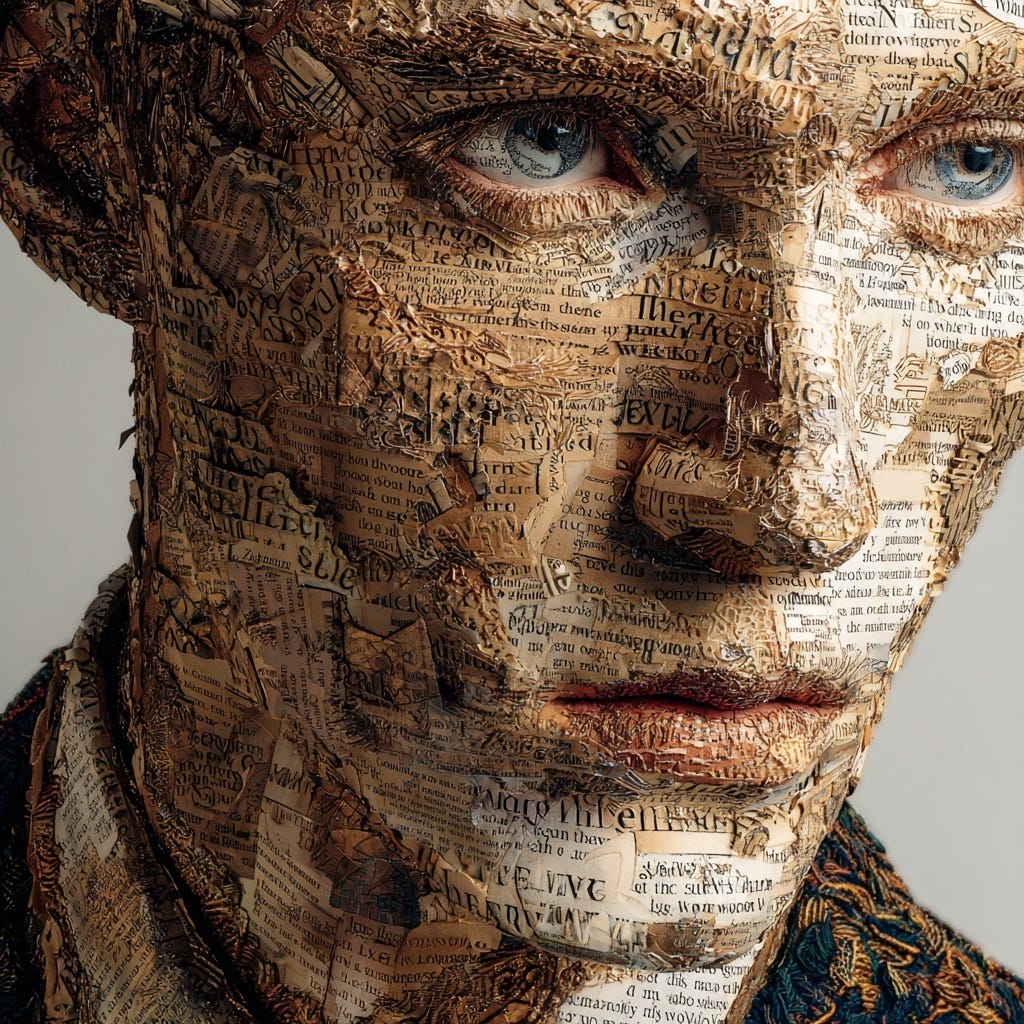
The self is not a pure substance. It is a sediment.
This is the important point in the original thought: what you are now is not something deliberately made. No one sat down in a laboratory and designed you. You are an amalgamation of dashed hopes, accidental incentives, defensive adaptations, inherited temperaments, social rewards, private shames, copied gestures, half-digested books, old injuries, and some genuine perceptions. Some parts of you are noble. Some are merely useful. Some are obsolete. Some are cowardice with a good explanation.
So the question is not whether you should “be yourself.” The question is: what kind of thing is the self, such that being it could be either wisdom or disaster?
That is a much harder question. It is also the only one worth asking.
II. What You Are Made Of
Let’s try to be precise.
The ordinary self is not one thing. It is at least six things confused under one name.
First, you are temperament. Before you had opinions, you had tendencies. Some people are more anxious, more aggressive, more open, more cautious, more sensual, more abstract. This is the biological weather of the self. It is not destiny, but it is never irrelevant.
Second, you are memory, including memory you cannot narrate. A lot of what you call personality is the body remembering what the mind has forgotten. You flinch before you know why. You distrust before there is evidence. You want approval from people you do not even respect. Hume thought the self, when inspected directly, was not a single thing but a “bundle” of perceptions. That may be too thin a picture, but it catches something true: when you look for the self as a solid object, you mostly find a sequence of impressions, affects, recollections, and expectations pretending to be a unity.
Third, you are imitation. René Girard made this central: human desire is mimetic. We do not simply want things. We learn what to want by watching what others want. Even rebellion is often imitation with the sign reversed. The person who says “I don’t care what anyone thinks” is often still organized by the imagined gaze of others. They are not free of the audience. They have merely chosen the role of defying it.
Fourth, you are defense. Much of the self is a system for avoiding intolerable feelings. Pride avoids shame. Irony avoids sincerity. Coldness avoids dependence. Busyness avoids emptiness. Moral superiority avoids envy. Intellectualization avoids grief. The defended self is not fake in a simple sense. It was built for a reason. But a bunker is not a home.
Fifth, you are social inscription. Foucault would be useful here, though not in the cartoon version where everything is power and therefore nothing is real. His deeper point is that selves are produced by practices: schools, families, clinics, confession, surveillance, categories of normality and abnormality. You do not discover yourself in a vacuum. You inherit a grammar of self-description. Even the sentence “I am being authentic” belongs to a historical regime that taught people to look inward and speak about themselves in certain ways.
Sixth, you are aspiration. This is the part most theories of authenticity underplay. You are not only what formed you. You are also what calls you. You are the strange animal that can be ashamed of what it is, not merely because others disapprove, but because it has glimpsed a higher form of itself. Aristotle would call this the movement toward excellence, toward eudaimonia, the flourishing proper to the kind of being you are. Kierkegaard would say the self is not a thing but a relation that must relate itself properly to itself. Nietzsche would say you must give style to your character.
These six layers do not agree. That is why “be yourself” is such shallow advice. The self is not a monarch issuing commands. It is a parliament, a battlefield, a ruin, a workshop, and sometimes a conspiracy.
To be yourself without further qualification is simply to let the loudest faction govern.
III. The Myth of the Uncorrupted Core
A lot of modern authenticity depends on a Rousseauian hope: beneath society’s corruptions, there is a more natural, innocent self. Civilization falsifies us. Convention distorts us. Return inward, and you find something truer.
There is something beautiful in Rousseau’s suspicion of social vanity. He understood how much of life becomes theater. He saw that people compare themselves into misery. He saw that society creates artificial desires, then judges people for failing to satisfy them.
But the myth of the pure inner self is dangerous.
The inner is not automatically innocent. The private self may be less censored, but it is not therefore more true. Envy is inner. Resentment is inner. Sadism can be inner. So can cowardice, vanity, domination, and self-pity. To say that something comes from within tells us almost nothing. The question is not whether it is internal. The question is whether it has been clarified.
Augustine knew this better than Rousseau. In the Confessions, inwardness is not a garden of authenticity. It is a depth full of conflict. The self is opaque to itself. It wants what it does not want to want. It loves wrongly. It is divided. Augustine’s famous question is not “How can I express myself?” but “Why am I not transparent even to myself?”
That is the more serious beginning.
The self is not hidden because society covered it. The self is hidden because it is internally disordered.
Plato would have understood this too. In the Republic, the soul is not a simple unity. It has appetitive, spirited, and rational parts. Justice in the soul is not self-expression. It is order. The better self is not the self that lets every part speak equally. It is the self in which the right part governs. Plato may be too hierarchical, too suspicious of appetite, but his basic insight is devastating to cheap authenticity: the soul can be badly governed.
When someone says, “I was just being myself,” Plato’s answer would be: which part of yourself had seized the city?
IV. Authenticity as Evasion
There is a peculiar modern form of dishonesty that presents itself as honesty.
It says: “I’m just being real.”
Or: “This is my truth.”
Or: “I can’t help how I feel.”
Or: “This is just who I am.”
These sentences often mark the exact point where thought stops.
To “be yourself” can become a way of evading three burdens.
The first is the burden of interpretation. Your feelings do not interpret themselves. Anger may mean that someone wronged you. It may also mean that they touched your vanity. Anxiety may mean danger. It may also mean novelty. Desire may mean love. It may also mean hunger for validation. The raw feeling is not yet knowledge. It has to be read.
The second is the burden of hierarchy. Not everything in you has equal authority. Some desires are deeper than others. Some are more yours because they survive reflection. Harry Frankfurt made this point with his distinction between first-order and second-order desires. You may want to lash out, but also want not to be the kind of person who lashes out. Which desire is more truly yours? Frankfurt’s answer is that personhood involves identifying with some desires rather than others. The self is not the set of all impulses. It is the structure of endorsement among them.
The third is the burden of responsibility. Once you define a trait as “who I am,” you make criticism feel like annihilation. If my cruelty is “my honesty,” then asking me to be less cruel sounds like asking me to be less myself. This is very convenient. It turns moral laziness into identity protection.
So “being yourself” can be an evasion. It lets the inherited self avoid judgment by calling itself authentic.
But perhaps the inherited self deserves judgment.
V. What It Means Not to Be Yourself
To not be yourself does not mean becoming artificial.
It means refusing to identify with the merely given.
This is the key distinction. There is a difference between what is in you and what is you. A thought can occur in you without deserving your signature. A desire can move through you without becoming your law. A wound can explain you without owning you.
Kant is useful here because he gives one of the strongest accounts of dignity as self-legislation. For Kant, freedom is not doing whatever inclination suggests. That is heteronomy: being ruled by something contingent, even if it is inside you. Real freedom is autonomy, acting according to a rational law one can will. Put less technically: you are not most yourself when you obey impulse; you are most yourself when you act from a principle you can respect.
This reverses the usual idea. People think discipline suppresses the self. Kant thinks discipline may be what rescues the self from slavery to appetite and circumstance.
The Stoics thought similarly. Epictetus begins with the distinction between what is up to us and what is not. Your body, reputation, possessions, and other people’s actions are not fully up to you. Your judgments are. The Stoic self is not the bundle of feelings that happens to arise. It is the faculty capable of examining impressions before assenting to them.
That word, assent, matters.
A feeling appears. You do not choose its appearance. But you may choose whether to ratify it. The self, in the higher sense, is not the place where impulses appear. It is the place where they are judged.
To not be yourself, then, means: do not confuse occurrence with authority.
Something can happen inside you and still not be worthy of you.
VI. The Better-Than-Self
What does it mean to be better than yourself?
It cannot mean becoming someone else. That fantasy usually ends in resentment or fraud. Nor can it mean becoming perfect, which is merely narcissism disguised as ethics. To be better than yourself means becoming more answerable to what you already recognize as higher than your present condition.
This is why shame, properly understood, is not always bad. There is toxic shame, which says “I am unworthy of love.” But there is also revelatory shame, which says “I have acted beneath what I know.” That kind of shame implies dignity. A creature incapable of betterment could not experience it.
Aristotle’s concept of virtue helps because it avoids both romantic spontaneity and puritan repression. Virtue is not against nature. It is perfected nature. The courageous person is not someone without fear. He is someone whose fear has been trained into proportion. The generous person is not someone without attachment to money. She is someone whose attachment has been placed under a better ordering. Virtue is what happens when the raw self is educated into form.
Nietzsche, strangely, belongs here too. He is often treated as the patron saint of self-expression, but he despised mere release. His ideal is not the person who “lets it all out.” That is closer to the last man than to the creator. Nietzsche’s higher person transforms drives into style. He does not amputate the chaotic parts of himself; he composes them. The question is not “How do I express my instincts?” but “What form could make even my dangerous instincts serve something magnificent?”
This is a much deeper authenticity. The self is not found by removing constraint. It is created by imposing the right constraint.
A poem is not less itself because it has form. Music is not less expressive because it has rhythm. A person is not less authentic because they have character.
Character is form applied to impulse.
VII. The Self as Project
Kierkegaard’s definition of the self may be the most useful: the self is a relation that relates itself to itself.
This sounds abstract until you notice how exact it is. A dog is angry; it does not ask what its anger means. A human being is angry and then has a relation to being angry. He is ashamed of it, proud of it, frightened by it, identified with it, amused by it, or suspicious of it. Human beings do not merely have states. They interpret themselves having states.
That reflexivity is the birthplace of the self.
But it is also the birthplace of despair. For Kierkegaard, despair is not merely sadness. It is a misrelation in the self. One form of despair is not wanting to be oneself. Another is wanting defiantly to be oneself without receiving the conditions of one’s existence. Both are failures.
This maps perfectly onto the problem of authenticity. The conformist refuses to be himself. The impulsive authenticist refuses to become himself. One dissolves into the crowd. The other freezes the self at the level of accident.
The real task is neither.
The task is to receive what you are, but not worship it.
Heidegger gives another version of this in his distinction between authenticity and the they. Most of the time, he says, we live as “one” lives: one gets a job, one has opinions, one wants what one is supposed to want. Authenticity begins when one confronts one’s own existence as one’s own, especially under the pressure of mortality. Death individualizes. It strips away the anonymous “they” and asks: what are you doing with this finite life?
But even Heideggerian authenticity can be misunderstood as mood. It is not enough to feel intensely that my life is mine. The question remains: what form should this mine-ness take?
Sartre radicalizes this. For him, existence precedes essence. There is no fixed human nature that excuses you. You become through choice. Bad faith occurs when you pretend to be a thing with a fixed essence: “I am just a waiter,” “I am just jealous,” “I am just this kind of person.” Sartre would hate “that’s just who I am,” because it treats a free being as an object.
But Sartre also shows the terror of the problem. If I am not simply my past, not simply my traits, not simply my role, then I am responsible for what I make of them. Freedom is not comfort. It is exposure.
VIII. The False Depth of Impulse
One reason people trust impulse is that it feels deep.
A sudden anger feels more authentic than a considered sentence. A confession at midnight feels more real than a careful conversation the next day. A destructive passion feels more profound than a stable commitment.
But intensity is not depth.
This may be one of the central errors of modern life: confusing force with truth. A thing can be loud because it is primitive, not because it is profound. The infantile parts of us often speak with great intensity because they have no other method. They cannot persuade, so they flood.
Freud complicates the picture. He showed that the ego is not master in its own house. Much of what moves us is unconscious, displaced, symbolic, irrational. But Freud should make us less trusting of authenticity, not more. If the unconscious speaks in symptoms, substitutions, projections, and repetitions, then “expressing yourself” may simply mean acting out a script you do not understand.
The Freudian question is not “How do I become free by saying whatever I feel?” It is “What hidden drama am I repeating while believing myself spontaneous?”
That is a brutal question. It should be asked more often.
The person who repeatedly chooses unavailable partners may say they are following their heart. Perhaps. Or perhaps their heart has been trained to confuse longing with love. The person who sabotages success may say they value freedom. Perhaps. Or perhaps success threatens an old loyalty to failure. The person who erupts in anger may say they are passionate. Perhaps. Or perhaps anger is the only emotion their childhood permitted them to feel with dignity.
In such cases, being yourself means remaining possessed by what you have not understood.
IX. The Ethical Shape of Emotion
There is another mistake: thinking that because emotions are involuntary, their expression is innocent.
This does not follow.
You may not choose the first arising of jealousy, but you choose whether to interrogate, accuse, spy, punish, confess, sublimate, or wait. Emotion is raw material. Expression is already ethics.
Here Iris Murdoch is helpful. She thought moral life was not primarily a sequence of dramatic choices, but a discipline of attention. We become better by learning to see others more justly. A selfish person does not merely choose selfishly after seeing clearly. He sees falsely. He sees others as obstacles, mirrors, instruments, threats. Moral improvement is therefore a purification of vision.
This changes the meaning of authenticity. Suppose I feel neglected by someone. The cheap authentic move is to express the feeling immediately: “You don’t care about me.” But Murdoch would ask whether I have seen the other person accurately. Have I attended to their fatigue, their fear, their separate reality? Or have I converted them into a character in the drama of my deprivation?
A lot of what we call authenticity is actually failed attention.
To be better than yourself is to see more truthfully than your woundedness naturally sees.
Simone Weil goes even further: attention is a form of love. Real attention requires suspending the self, making room for the reality of another. This is almost the opposite of self-expression. Yet it may be a higher authenticity, because the self that can attend is more real than the self that merely reacts.
The reactive self fills the world with itself. The attentive self allows the world to appear.
X. Relationships and the Refusal of Rawness
In relationships, the cult of being yourself becomes especially destructive because intimacy rewards rawness while requiring form.
To love someone is to be seen by them. So naturally we want to bring our unedited selves. We want to be accepted without translation. We want someone to witness the basement and not leave.
This is understandable. But it contains a temptation: to confuse intimacy with dumping.
The fact that someone loves you does not mean they should be made to live inside your unprocessed material. Love is not a license to outsource self-regulation. It is not a demand that another person admire every maladaptive strategy that once helped you survive.
There is a cruel innocence in people who say: “I’m only showing you how I feel.” But showing can itself be an act. Tone is an act. Timing is an act. Repetition is an act. Refusal to repair is an act. Theatrical despair is an act. Silence is an act. Even helplessness can become an act when used to control the emotional field.
This is why “I didn’t mean to hurt you” is often morally insufficient. Intention matters, but form matters too. If your way of being consistently injures people, then the form of your self has ethical consequences regardless of your preferred self-description.
Levinas would say the face of the other interrupts my freedom. The other person is not merely material for my becoming. Their vulnerability commands me before I choose. This is a needed correction to heroic self-creation. The task is not only to become magnificent. It is to become non-violent in the presence of another person’s reality.
Not harmless. Harmlessness is too low a goal. Love will sometimes hurt because truth hurts, separation hurts, growth hurts. But there is a difference between necessary pain and surplus cruelty.
A mature person learns to remove the surplus.
That is one of the most concrete meanings of becoming better than yourself: you still tell the truth, but you stop adding poison.
XI. The Vertical Dimension
The original text uses a powerful image: the problem is not to move from one end of the axis to the other. Not from conformity to self-expression. Not from people-pleasing to impulsiveness. You have to move perpendicular to the axis.
This is exactly right.
Most advice assumes a horizontal line:
Society ←→ Self
On one side: conform, obey, perform.
On the other: express, rebel, be yourself.
But both sides can be stupid. Society can be false, and the self can be false. Convention can deform you, and impulse can deform you. The crowd can lie, and so can your wounds.
The better movement is vertical:
Lower self → higher self
But “higher” needs careful definition. It does not mean more socially approved. It does not mean more controlled in a bourgeois sense. It does not mean nicer, smoother, more employable, more therapized, or more palatable.
Higher means more integrated, more truthful, more capable of love, more capable of action without self-deception, more capable of suffering without becoming cruel, more capable of desire without becoming enslaved, more capable of solitude without becoming resentful, more capable of intimacy without becoming devouring.
The higher self is not less intense. It is less chaotic.
It is not less emotional. It is less possessed.
It is not less free. It is less accidental.
XII. What You Are Evading
When someone insists too quickly on being themselves, what are they often evading?
They may be evading the grief of lost innocence. It is painful to admit that not every part of you is beautiful. Easier to sanctify the whole mess as authenticity.
They may be evading the humiliation of effort. To improve is to admit lack. Some people would rather be “deeply flawed” than be beginners at goodness.
They may be evading the responsibility of choice. If I am “just this way,” then I do not have to choose what to become. My past becomes my alibi.
They may be evading the terror of freedom. Sartre saw this clearly. A fixed identity is comforting even when it is miserable. “I am broken,” “I am avoidant,” “I am too intense,” “I am not the relationship type”—these can become little prisons one decorates.
They may be evading the demand of love. Love asks for transformation. Not because the beloved tyrannically demands it, but because closeness reveals where one’s form is inadequate. If I love you, my anger can no longer be merely my anger. It is now weather you must endure. My despair can no longer be merely my despair. It now has gravity in your life.
They may be evading judgment. Not judgment by the crowd, but judgment by the best part of themselves.
That last one is the most important. The real judge is often internal. Not the superego merely, not the inherited voice of parental disapproval, but something quieter and more exacting: the knowledge that one is living beneath oneself.
XIII. The Art of Selfhood
So what should replace authenticity?
Not sincerity alone. Sincerity only means that the lie has become unconscious.
Not spontaneity. Spontaneity may be grace, but it may also be regression.
Not self-acceptance, though self-acceptance is necessary. Acceptance is where the work begins, not where it ends.
The better ideal is self-authorship.
But authorship is not arbitrary invention. A good author does not force any plot onto any material. The material resists. It has tendencies, limits, possibilities. The author listens and shapes. That is also how a person becomes better.
You do not get to choose your raw material. You may be anxious, proud, depressive, sensual, intellectual, suspicious, needy, ambitious, easily wounded, easily bored. Fine. That is the material. The question is what can be made from it.
An anxious person may become perceptive rather than controlling.
A proud person may become noble rather than vain.
A wounded person may become compassionate rather than manipulative.
An intense person may become devoted rather than overwhelming.
A skeptical person may become discerning rather than cynical.
An ambitious person may become excellent rather than merely successful.
The higher self is usually not the negation of the lower self. It is its transfiguration.
This is why Nietzsche’s “give style to one’s character” is so powerful. Style does not mean decoration. It means necessity achieved through form. In a person, style means the drives have been arranged so that even the dangerous ones contribute to the whole.
The goal is not to have no demons. The goal is to prevent the demons from conducting the orchestra.
XIV. The Final Reversal
At first, “don’t be yourself” sounds like self-rejection.
But maybe the opposite is true.
Maybe “just be yourself” is the real form of contempt, because it assumes the current self is all there is. It treats you as a finished object. It says: here are your wounds, your habits, your defenses, your inherited scripts, your familiar reactions. Express them. Find someone who accepts them. Call that love.
That is not love of the self. That is resignation.
To believe in the self is to believe it can become more true than it currently is.
The self is not a fact to be expressed. It is a form to be achieved. It is not hidden intact beneath convention. It is distributed across memory, body, imitation, defense, desire, conscience, and aspiration. It contains fossils and prophecies. To “be yourself” in the shallow sense is to obey this mixture. To be yourself in the deeper sense is to order it.
So the work of being yourself is paradoxical. You must stop being yourself in order to become yourself.
You must stop identifying with the first reaction.
You must stop calling your defenses your personality.
You must stop mistaking intensity for truth.
You must stop treating wounds as credentials.
You must stop using authenticity as immunity from criticism.
You must stop asking to be loved exactly as you are, if “as you are” includes refusing to become less harmful.
And yet you must not become fake. You must not become merely acceptable. You must not sand yourself down into social usefulness. You must not betray the living center in order to become convenient.
The task is harder than either conformity or self-expression.
You have to preserve the fire and improve the form.
That is what it means to be better than yourself: not to become other than yourself, but to become the version of yourself that your best moments have already accused you of being capable of.
“Be yourself” is not wrong because authenticity has no value. It is wrong because authenticity is not a starting point. It is an achievement.
The self is not something you simply uncover.
It is something you answer for.