What does it mean for a nation to be holy?
Not “nice.” Not “morally flawless.” Not “better than others” in some nationalist sense.
Holiness, in its deepest sense, is terrifying: it means that your life, your history, your power, your failures are not just your private business. They stand under judgment – by God, by conscience, by the eyes of those who come after you. Holiness is the decision to live as if that judgment is real.
Israel is one of the very few modern nations that ever dared to talk about itself in that way. Not just as a state, but as a people with a covenant, with a story that doesn’t begin in 1948 and doesn’t end at any border. A people that remembers slavery and gas chambers and exile, and then says: we will have power again – and we will not forget what it means to be powerless.
That is an insane level of ambition.
And for a long time, Israel actually lived toward that ambition in a way that was genuinely extraordinary. It did not become a utopia – it became something harder and in some ways more impressive: a country that remembers its own suffering and still tries to restrain itself.
That is the holy core that makes current abuses so painful. You can only “betray” something that was real in the first place.
1. What is holiness, really?
Before talking about Israel, it helps to zoom out.
The Hebrew word kadosh – “holy” – literally means “set apart,” “other,” “withdrawn from ordinary use.” But in the Jewish tradition, holiness is not just separation. It’s a particular way of being separate:
Separate in order to serve, not to dominate.
Different in order to be responsible, not in order to feel superior.
Distinct, but porous: open to the stranger, the orphan, the widow.
A holy life is one that knows it is being watched – not by cameras, but by an invisible moral gaze. A holy person asks: “If someone could see everything I do, how I treat the weak, what I do with my power – would I be able to look them in the eye?”
Now, can a nation be holy? Or only individuals?
Strictly speaking, only individuals can make choices. But a nation can:
choose an institutional architecture that makes it easier or harder to act justly,
cultivate a culture that either rewards conscience or punishes it,
tell stories that either dull the sense of responsibility or sharpen it.
So a “holy nation” is not a nation full of saints. It’s a nation that:
builds structures that limit power,
nurtures a memory that includes not only victories but also sins,
allows a language in which self-criticism is considered loyalty, not treason.
By that definition, Israel – against all odds – has often come shockingly close to this ideal. And that makes its current trajectory feel not just politically dangerous, but spiritually tragic.
2. Israel as a holy experiment
Most modern states are born from deals, wars, dynasties, or accidents. Israel is born from all of that – and from theology.
You don’t have to believe in God to see that. The project is visibly religious even from the outside: a people emerging from catastrophe, returning to its ancient center of gravity, trying to translate words like covenant, justice, exile, memory into institutions, laws, and daily life.
From the beginning there was a double promise:
We will survive. We will never again be led like sheep to slaughter. We will defend ourselves.
We will not become what we experienced. Power will not erase our memory of what it feels like to be crushed.
Those two promises, together, are what give the talk of “holiness” any meaning. Without the first, holiness becomes sentimental: moral purity without survival. Without the second, holiness becomes a joke: survival at any cost, with the language of ethics used only as decoration.
For decades, Israel tried – with countless failures along the way – to hold both.
Let’s linger on the good for a moment, because it matters.
3. The good: how Israel actually lived its calling
3.1 A democracy built by the traumatized
It is easy to miss how strange this is.
The people who built the institutions of the state were refugees, survivors of pogroms and death camps, people who had watched law and courts turn to ash. If anyone had a right to say “law is a joke,” it was them.
And yet:
They created elections.
They built a Supreme Court that could check the government.
They allowed a ferociously free press that mocked leaders, debated wars, dug into scandals.
That is not normal. That is a generation saying: we have seen what happens when the state becomes absolute – and we will bind our own hands.
Holiness, at the level of institutions, is exactly that: voluntarily limiting your own power when no one can force you to.
3.2 The culture of argument as a form of holiness
Israeli culture is famously argumentative. Everyone is shouting; nobody is polite. But under the noise, there is something precious: a deep refusal to shut up in the face of power.
Generals writing books admitting mistakes.
Soldiers talking openly about their dilemmas.
Films and novels that portray the occupation, discrimination, war trauma, and political corruption without mercy.
Demonstrations and petitions by reservists, pilots, academics.
Holiness here is not in “being right.” It is in maintaining a language where you can say, “This is wrong, this is not us,” without being immediately crushed.
A nation that encourages its own self-critique is a nation that understands: we are not immune to evil just because we were victims of evil.
3.3 An army that at least tries to have a conscience
No army is clean. All war is dirty. But it is not nothing that the IDF:
codified ethical guidelines,
integrated legal advisers into operational decisions,
at least sometimes investigated its own soldiers,
at least sometimes cancelled operations to avoid civilian casualties.
From the outside, critics often dismiss this as PR. And yes, sometimes it is abused as PR. But the internal fact remains: Israeli soldiers grow up hearing that there is such a thing as an immoral order, that there are limits, that they carry not only a rifle but a moral responsibility.
Holiness here is the very idea that guns are not morally neutral. That how you fight matters, even when your cause is just.
3.4 Responsibility for Jews beyond the border
One of Israel’s most remarkable qualities has been its stubborn sense of responsibility for Jews it has never met:
airlifts of Ethiopian Jews,
political and financial pressure to free Soviet Jews,
operations to rescue or protect communities in danger,
the simple psychological fact that a Jew anywhere in the world can say: “If everything falls apart, there is one place that will take me.”
This is a global version of holiness: the refusal to say, “Those are someone else’s Jews.” It is the belief that peoplehood is not an abstract word but a duty that can cost money, risk, and diplomatic capital.
3.5 Compassion that crosses enemy lines
You can walk through hospital wards and find:
wounded Syrian civilians treated anonymously,
children from Gaza or the West Bank undergoing surgeries,
victims of disasters in faraway countries receiving care from Israeli teams.
These acts do not erase structural injustices or political decisions. But they matter. They are small flames that say:
Even in the middle of conflict, even with enemies, we will not forget that a suffering human is a suffering human.
Holiness is not only in big doctrines. Sometimes it is in a nurse who treats a child whose father sees her country as the enemy.
3.6 Turning trauma into creativity, not only walls
The same society that lives with constant reminders of Auschwitz, rockets, and sirens has produced:
breakthrough technologies in agriculture, medicine, cybersecurity,
a wildly creative arts scene,
some of the most open queer spaces in the region,
philosophical, theological, and literary work that wrestles honestly with guilt, fear, and responsibility.
This matters because trauma often tempts people to shrink, to close, to freeze. Israel’s better impulse has often been the opposite: to take trauma and transmute it into invention.
If holiness is partly about refusing to let evil define your final form, then every start-up, every novel, every scientific breakthrough is a modest sanctification of life against death.
4. Power as the test of holiness
All of that is real. But holiness is not proven by beautiful parts of your story. It is proven precisely where it hurts: in what you do with your power when you no longer feel helpless.
For centuries, Jews had no power. They depended on the conscience—or lack of conscience—of others. Now suddenly there is:
an army,
secret services,
control over borders and airspace,
nuclear weapons,
economic leverage.
Power is not evil. For a people that faced genocide, power is a miracle. But from the standpoint of holiness, power is also an exam.
The dangerous temptation is always the same:
“What was done to us was unjust. Therefore, whatever we do to prevent it from happening again must be just.”
That is emotionally understandable. It is also false.
The test of holiness is whether you can break that chain. Whether you can say:
“Yes, we will defend ourselves. But we will not dissolve our own conscience in the acid of trauma.”
“Yes, we will take up the sword. But we will listen to judges, prophets, critics, even when they make us hate ourselves.”
This is where politics becomes spiritual. Because the easiest way to avoid this inner struggle is to find a leader who promises:
“I will make you safe, and I will make you feel righteous while you do whatever it takes.”
That promise is the opposite of holiness. It is the promise of comfort instead of conscience.
5. The slow erosion: from covenant to convenience
Israel’s current crisis is not a single event. It’s a drift – a slow spiritual erosion that becomes visible in political form.
The drift looks like this:
From covenant (“We will hold ourselves to these standards even when it hurts”)
to convenience (“We will hold these standards when they cost us nothing”).From law as limit (“No one is above judgment, not even the prime minister”)
to law as obstacle (“Judges are blocking the will of the people / my vision / our safety”).From prophecy (“We must hear hard truths about ourselves”)
to PR (“We must silence hard truths because they hurt our image”).From self-criticism (“We have done wrong and must change”)
to self-pity (“The world hates us, so any criticism is proof of their hatred”).
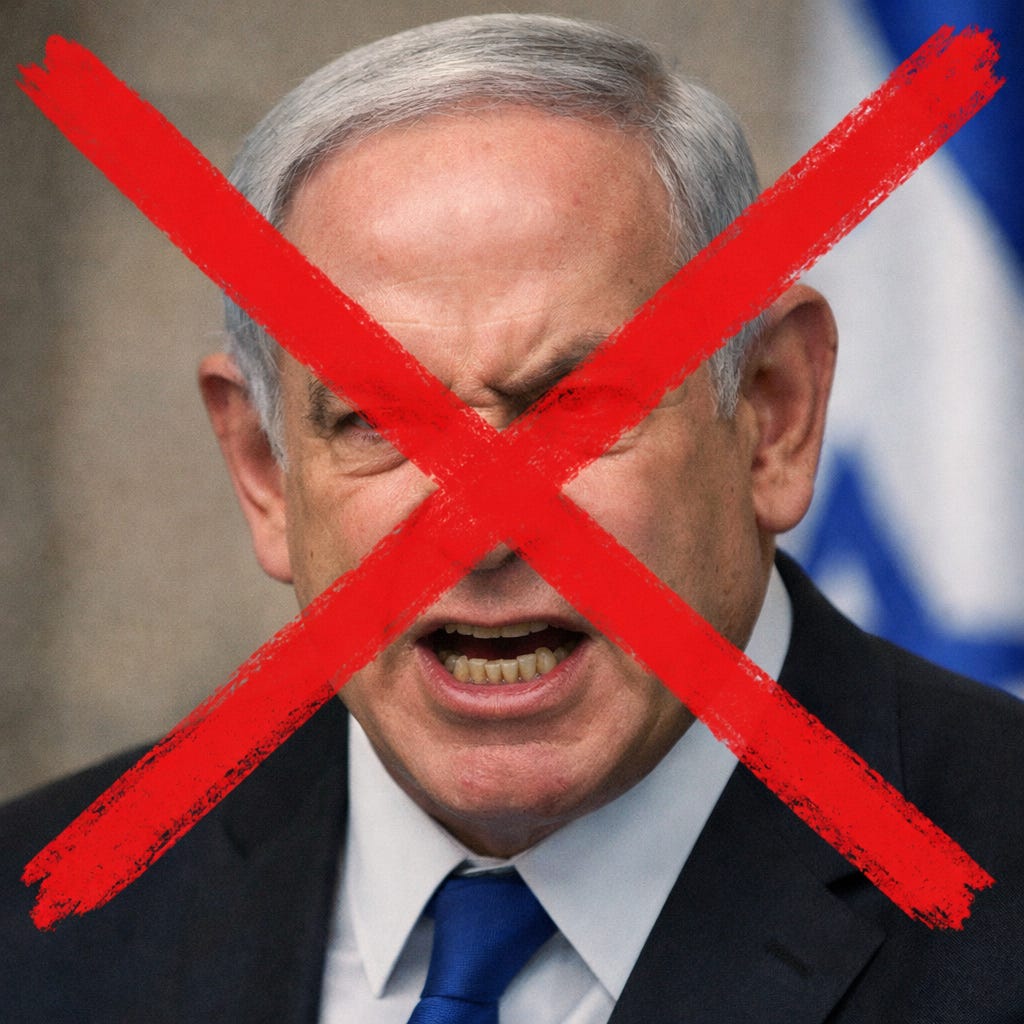
Benjamin Netanyahu is not the origin of this drift. But he is its most skilled surfer. He has built a politics that feeds off fear, fatigue, and wounded pride. And in doing so, he has done more than damage institutions – he has helped normalize a mindset that treats holiness as branding instead of responsibility.
6. Netanyahu as a symbol of the crisis
It’s important to be precise: the problem is not that one individual is “evil.” The deeper issue is that he embodies a certain relationship to power and memory.
Consider a few traits:
6.1 Power before principle
When a leader under serious legal investigation chooses to attack the very institutions that are judging him, he is implicitly saying:
“My power is more important than the integrity of the system that keeps us honest.”
That cuts against the core of holiness, which always says: no one is above judgment.
6.2 Fear as permanent fuel
Netanyahu is exceptionally articulate about danger. Many of the threats he describes are real. But his political genius lies in turning fear into a permanent atmosphere. Fear weakens the public’s appetite for moral complexity. It makes slogans (“security,” “loyalty,” “unity”) feel like enough.
Holiness requires the opposite: the courage to think ethically precisely when you are afraid.
6.3 Delegitimizing inner conscience
When judges, journalists, demonstrators, or security veterans are painted as traitors or fools for criticizing policy, something sacred is being damaged.
The “holy nation” idea requires an internal prophetic voice: someone has to be allowed to say: “We are powerful, and we are wrong here.” If that voice is systematically attacked, holiness becomes pure self-congratulation.
6.4 Confusing Israel with its leader
Perhaps most dangerous is the attempt—sometimes explicit, often implicit—to equate criticism of the leader with hostility to the state.
If “Netanyahu = Israel,” then to question him is, by definition, to endanger Israel. That logic paralyzes the conscience of citizens: they begin to doubt whether loyalty allows them to object.
But a genuinely holy nation is precisely the opposite: it insists that no leader, no faction, no government owns the word “Israel.” The people, with their memory and conscience, are larger than whoever temporarily sits in office.
7. The deepest conflict: memory vs. justification
At the deepest level, Israel is struggling with one terrifying question:
What do we do with our memory of being victims?
There are two options.
Option 1: Memory as vow
“We know what it means to be crushed and dehumanized. Therefore we will never treat others as sub-human. We will defend our lives fiercely, but we will not lose the capacity to see the face of the other.”
This is holiness: memory turned into responsibility.
Option 2: Memory as excuse
“We know what it means to be victims. Therefore, whatever we do in the name of survival is beyond serious moral scrutiny. Anyone who questions us doesn’t understand or doesn’t care about our suffering.”
This is spiritual suicide: memory turned into exemption.
The greatness of Israel, at its best, was that it leaned toward the first option. It tried to be a place where trauma is neither denied nor weaponized, but worked through—in debates, courts, art, and law.
The danger of the present moment is that political leaders are pushing, often without saying it out loud, toward the second option. Toward a state in which suffering becomes a blank cheque.
And that is where holiness is not just “less visible.” It is directly contradicted.
8. Can a holy nation fail and still be holy?
Here’s the hard truth: a holy nation is not one that avoids failure. It is one that refuses to stop wrestling with its failures.
The biblical pattern is clear: Israel sins, prophets shout, things collapse, people repent (partly), they try again. There is no golden age of perfection. There is a long, exhausting argument between power and conscience.
So the question is not: “Has Israel failed?” Of course it has. The question is:
“Is Israel still willing to hear its own prophets, its own judges, its own internal critics – or will it silence them to avoid shame?”
As long as a society can be ashamed of itself, it is still spiritually alive. Shame is painful, but it is a sign that you remember your ideals.
The fear with the current leadership is that it is trying to protect the nation from shame by numbing it – by calling shame “self-hatred,” by calling responsibility “weakness,” by calling empathy “naivety,” by calling concern for others “betrayal.”
Numbing works in the short term. But a numb nation cannot be holy. It can be strong, rich, even temporarily secure – but not holy.
9. Returning to holiness: what would it look like?
If holiness is a direction, not a medal, then the urgent question is: what would it mean for Israel to turn itself again toward that direction?
Not in the abstract, but concretely. It might look like:
Re-strengthening the courts even when they rule against national mood or military decisions.
Teaching history in a way that includes not only “what was done to us” but also “what we have done to others.”
Protecting internal dissent as a national asset, not a national threat.
Making room for mourning the suffering of others—including Palestinians—without seeing that as self-betrayal.
Holding leaders accountable, not because the world demands it, but because the people demand it: “You do not get to use our trauma as your shield.”
On a spiritual level, it would mean reclaiming the double promise:
“Never again to us.”
“Never again will we become blind to what we do.”
That second sentence is what distinguishes holiness from mere self-defense.
10. The last word
So: what does it mean to be holy?
For a nation like Israel, it does not mean glowing with moral perfection or being universally admired. It means living in a constant, uncomfortable conversation between power and conscience, between fear and responsibility, between survival and who we become while we survive.
Israel has already proven that it can live that way. Its best institutions, its best books and films, its best legal rulings, its most courageous citizens – all of these are tiny, stubborn embers of holiness. They show that it is possible to be traumatized and yet self-critical, armed and yet reflective, angry and yet capable of restraint.
Netanyahu’s tragedy is not only what he does wrong. It’s what he encourages Israel to forget about itself: that it once dared to believe its story mattered, morally, not just militarily.
The choice now is not between “holy Israel” and “unholy Israel.” The choice is whether Israel accepts becoming just another frightened, powerful state that uses its pain as armor, or whether it insists—against cynicism, against exhaustion, against the instincts of some of its own leaders—that its power must still answer to something higher.
If the word “holy” is to mean anything at all, it has to mean this:
We remember what was done to us, and we will defend ourselves.
But we also remember who we promised to be,
and we will not hand that promise over to anyone –
not to our enemies, and not to our own leaders.
As long as there are enough people in Israel who refuse to surrender that promise, the holy experiment is not over. It is simply in one of those dark chapters where the task of holiness is not to shine, but to refuse to go blind.