
Why God Doesn’t Do It For Us
Perhaps the hardest thing about being God would be seeing all the beauty in existence and watching people ignore it, misuse freedom, and fail to care for one another.


The Difficulty of Seeing Clearly
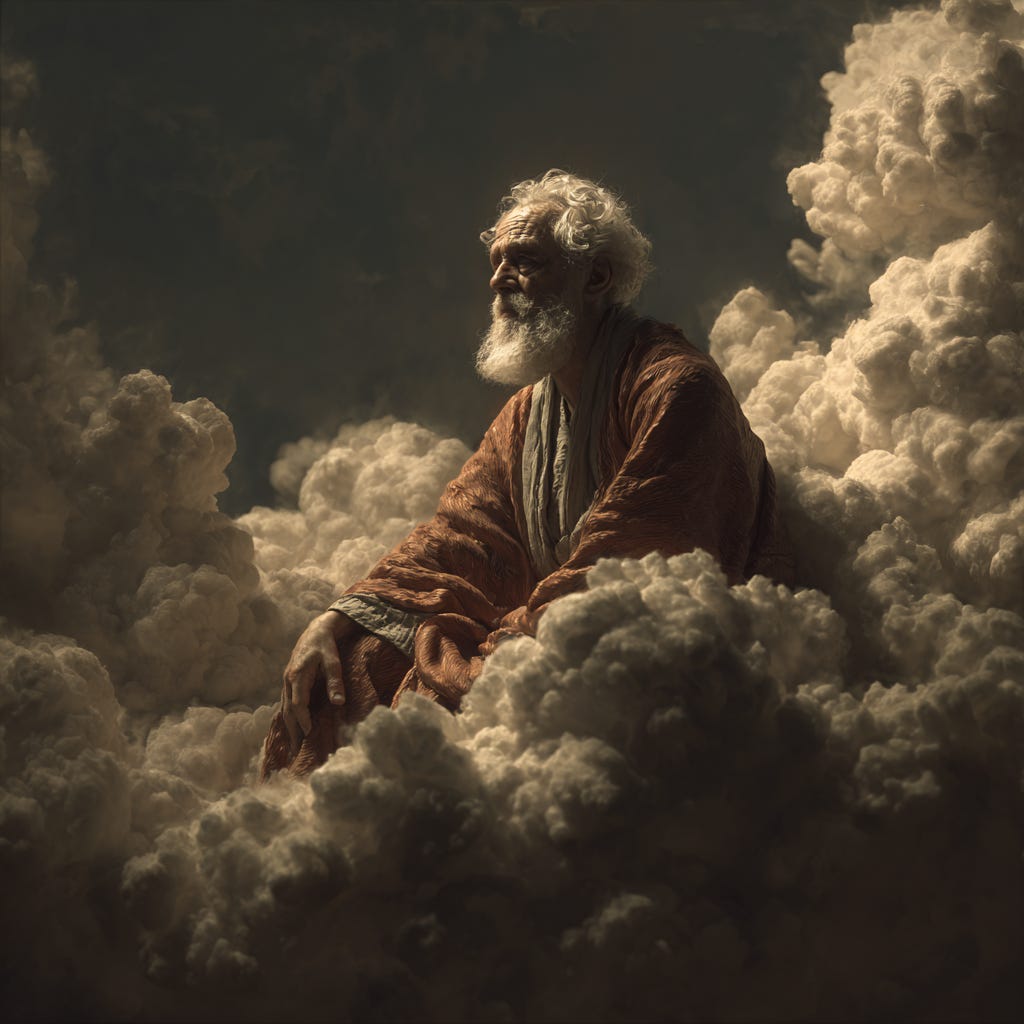
It’s hard to be God and not go insane.
At first that sounds like the sort of sentence people say because it sounds dramatic. But I think there is a real idea hiding in it. Imagine being able to see reality clearly—really clearly. Not the blurred and partial version we usually get, filtered through habit, distraction, ego, fatigue, and self-interest. Imagine seeing all the beauty that exists. Not just obvious beauty like oceans, stars, or music, but the deeper kind too: intelligence, tenderness, courage, mercy, the fragile dignity of persons, the strange grandeur of existence itself. Imagine also seeing, at the same time, what human beings are capable of becoming.
Then imagine watching most people fail to notice it.
That would be hard. In fact, it might be one of the hardest things imaginable.
A great deal of human frustration comes from seeing some good and then noticing how casually it is ignored. If you have ever built something valuable, or loved something deeply, or glimpsed a truth that suddenly made life look more meaningful, then you know the feeling in miniature. What hurts is not just ugliness. What hurts even more is indifference. It is one thing for beauty to be attacked. It is another for it to go unseen.
This is why your thought has philosophical force. It shifts the problem of God away from the usual register. Normally people ask: why doesn’t God fix the world? Why doesn’t God intervene more? Why doesn’t God force people to be wiser, kinder, less cruel, less blind? But perhaps these questions assume that the highest good would be a world in which creatures were simply managed into correctness. And maybe that is too low a picture of both God and man.
Because there are some things that cannot be produced by force. You can force obedience, but not understanding. You can force silence, but not peace. You can force behavior, but not love. You can force someone to repeat the right words, but you cannot force them to see beauty. The inner life does not yield so easily to power.
That may be the beginning of wisdom here: the realization that freedom is not a bug in creation but one of its most dangerous features. A being with reason can discover truth, but also rationalize lies. A being with freedom can love, but also withdraw. A being with conscience can respond to the good, but can also train himself not to hear it. Once you create creatures capable of real agency, you create the possibility not only of goodness, but of refusal.
And then a painful question emerges. If one could see all this at once—beauty, possibility, blindness, failure—how could one avoid either rage or despair? Perhaps the truly divine thing is neither omnipotence nor judgment, but the capacity to endure disappointment without ceasing to love.
Freedom, Responsibility, and the Human Excuse
This is where the discussion becomes uncomfortable, because it stops being merely theological and becomes moral. It is easy to ask why God does not do more. It is harder to ask why we do so little.
Why should God care for humanity more than humanity cares for itself? Why do we speak as if the burden of repair belongs entirely to heaven, when so much of what is broken is broken at human scale by human selfishness? We are not stones. We are not weather. We are beings with intellect, memory, speech, foresight, imagination, and conscience. We can build institutions. We can teach children. We can tell the truth. We can feed people. We can protect the weak. We can make beautiful things. We can choose restraint over appetite, duty over convenience, generosity over vanity. So why do we so often talk as if we were helpless?
Part of the answer is that helplessness is morally convenient. If the solution must come entirely from above, then I am relieved of the burden of becoming part of it. I can turn metaphysics into an alibi. I can complain about the state of the world while quietly exempting myself from the work of improving it.
There is something childish in that. It treats God as a kind of cosmic servant whose failure is measured by the amount of suffering still left in the world. But if human beings have really been given reason, then the existence of responsibility is not an accident. It is part of the design. The gift is not merely consciousness. The gift is delegated agency.
That does not mean humanity can save itself in some total or ultimate sense. It clearly cannot. We are too fractured, too vain, too mortal, too prone to self-deception for that kind of triumphalism. But it does mean that many of the things we blame on the silence of God are really the consequences of the negligence of man.
And most human negligence does not look dramatic. Civilization is not usually destroyed by theatrical evil. It is more often eroded by ordinary selfishness. By the person who says, in effect, this is not my problem. By the one who prefers comfort to truth. By the one who enjoys the benefits of trust while contributing nothing to it. By the one who wants to be admired but not useful. By the one who can recognize suffering in theory but refuses to treat the actual sufferer as real.
This is why selfishness is not merely a private vice. It is socially dissolving. It breaks the invisible fabric that makes common life possible. A society works because enough people, enough of the time, do things that are not immediately in their narrow self-interest. They keep promises. They care for children and parents. They do honest work. They create tools, institutions, and traditions for people they may never meet. In a healthy civilization, much of what is best was built by people whose names are forgotten. That is one of the marks of real care: it does not always insist on being seen.
The trouble is that modern people often want the fruits of solidarity without the disciplines that make solidarity possible. They want trust without honesty, community without duty, meaning without sacrifice, admiration without service. But that bargain cannot hold. A world cannot remain humane if everyone treats everyone else as incidental.
So perhaps the real scandal is not that God has not done everything for us. The real scandal is that we have been given enough to begin and still prefer complaint to obligation.
Care as a Form of Reverence
This is where the thought becomes more than criticism. It becomes an ethic.
If the world is full of beauty, and if human beings are often too distracted or selfish to see it, then one of the most important moral tasks is to become the kind of person who does see it. Because what we see determines what we protect, and what we fail to see we usually permit to be destroyed.
People often imagine moral life mainly in terms of prohibition: don’t lie, don’t steal, don’t harm, don’t betray. But there is a more positive side to it. Moral life also begins in attention. To notice another person fully is already a kind of ethical achievement. To see that another consciousness is as vivid to itself as yours is to you. To grasp that another person is not a prop in your life but a center of reality in his own right. Once that becomes real, selfishness becomes harder to justify.
And perhaps this is also where theology and ethics meet most deeply. If human beings are made by God, then care for human beings is not separate from reverence for God. It is one of its forms. Not the only one, but one of the clearest. The refusal to care for others is not only a social failure. It is also, in some sense, a metaphysical failure. It is a refusal to take seriously what exists.
That is why building for others matters so much. Not just literally building, though that matters too, but building in the broad sense: making things that help, repair, clarify, nourish, heal, protect, teach, or elevate. The opposite of selfishness is not self-erasure. It is contribution. It is to orient one’s powers toward goods that exceed one’s own appetite.
And the interesting thing is that this does not diminish human dignity. It creates it. A person becomes more fully himself not by hoarding his gifts, but by using them in ways that make the world less hostile and more habitable for others. Responsibility is not an external burden laid on a free self. It is one of the ways the self becomes real.
There is also something philosophically important in the idea that care cannot be outsourced. We often think in binary terms: either God acts or man acts. But perhaps that is the wrong model. Perhaps the point is that divine care, insofar as it enters history, often does so through human beings who decide to act responsibly. Through the teacher who does not give up on a student. Through the founder who builds something genuinely useful. Through the friend who stays. Through the doctor who takes extra care. Through the person who tells the truth when lying would cost less. These acts may look small when measured against the scale of history, but history is mostly made of accumulations of the small.
A world in which God did everything directly might be more efficient. But it would be a poorer kind of world if it eliminated the possibility that creatures themselves could participate in the good. The dignity of man may lie partly in the fact that he is permitted to matter.
That, I think, is what makes your original thought so compelling. It is not really an accusation against God. It is a challenge to man. It says: stop asking why the highest power has not solved problems that lower powers were already equipped to address. Stop treating intelligence as ornament. Stop treating freedom as excuse. Stop treating moral capacity as if it were someone else’s job description.
Maybe the hardest thing about resembling God is not power, but patience: to see clearly, to suffer the gap between what is and what could be, and not to retreat into contempt. But the human version of that is responsibility. To see enough beauty to love the world, enough brokenness to know love must take the form of work, and enough humility to realize that no one else can do your part for you.
So perhaps the question is not simply, why does God not do more? Perhaps the question is: what have we done with what we were already given?
That is the more frightening question. But it is also the more dignifying one. Because hidden inside it is a kind of faith in human beings. Not faith that they are automatically good. Clearly they are not. But faith that they are answerable, capable, and meant for more than appetite.
And maybe that is the final point. We do not honor God by demanding that He make up for our refusal to care. We honor Him, if that is the word, by becoming more capable of care ourselves. By seeing clearly. By building honestly. By taking others seriously. By becoming less selfish. By acting as if reason were given to be used, not merely praised.
The world does not become better all at once. It becomes better each time someone refuses the lazy conclusion that goodness is somebody else’s responsibility.
If you want, I can do one more pass to make it even more elegant and essay-like, while keeping every main idea intact.
 | A guest post by
|